
Per Pemberton
PhD. Forskare vid SMHIs oceanografiska forskningsenhet.
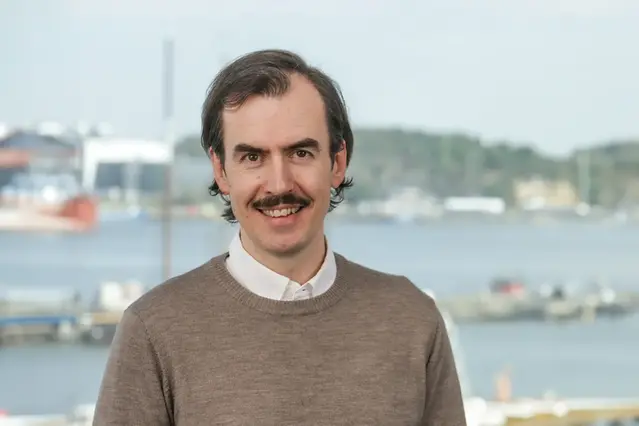
Per Pemberton
Kontakt, nätverk och CV
- E-post: per.pembertont@smhi.se
- Telefon: 031-751 89 84
- Research Gate: Per_Pemberton
- Per Pemberton, CV pdf, 245.4 kB.
Publikationer
Verksamhetsområden
Jag är forskare inom fysisk oceanografi med huvudinriktning på havs- och havsismodellering. Min forskning riktar sig främst till att förstå hur olika fysikaliska processer påverkar tillstånden i de Arktiska havet, Nordiska haven och Östersjön, och hur det kan komma att ändras med klimatförändringar. I min forskning försöker jag ofta sammanfoga resultat från avancerade storskaliga havsmodellsimuleringar med förenklade dynamiska teorier för att förstå vilka nyckelprocesser som styr de olika havsområdena.
Forskningsintressen
- Färskvattensprocesser och omvandling av vattenmassor i Arktiska oceanen (Doktors ämne)
- Dynamiska teorier för Arktiska oceanen
- Prediktabilitet
- Havs- och havsismodellering
- Fältstudier av havsis
- Marin fjärranalys
Response of a semi-enclosed sea to perturbed freshwater and open ocean salinity forcing
Lars Arneborg, Magnus Hieronymus, Per Pemberton, Ye Liu, Sam Fredriksson
Hypsographic Control on the Diapycnal Flow in the Eastern Gotland Basin of the Baltic Sea
Magnus Hieronymus, Per Pemberton, Robinson Hordoir, Erik Mulder
Hydrographic effects in Swedish waters of future offshore wind power scenarios
Lars Arneborg, Per Pemberton, Nathan Grivault, Lars Axell, Sofia Saraiva, Erik Mulder, Sam Fredriksson
I: RO, Rapport Oceanografi
2024
Sammanfattning
For two future scenarios on the expansion of offshore wind power in the Baltic Sea and the North Sea, SMHI has investigated how the hydrography, i.e. temperatures, salinities, currents and stratification, may be affected. Effects were induced by wind stress reductions on the sea surface and by the increased friction and turbulence in the water from wind turbine foundations.
The results show that an expansion of wind power in the Baltic Sea in general will cause a shallowed halocline, and increased deep water salinities and temperatures, due to decreasing winds behind the wind farms that lead to decreasing vertical mixing in the Baltic Sea. However, the magnitude of changes shows a strong sensitivity to assumptions about the wind stress reduction at the sea surface, and the size of wind power expansion.
The wind farm scenarios are prepared in collaboration with the Swedish Agency for Marine and Water Management (SwAM) and are based on marine plans from Sweden’s neighbouring countries as well as new proposals for suitable wind power areas that SwAM will present to the government in 2024. In one scenario, Scenario 1, it is assumed that there will be offshore wind in all proposed areas, while in the second scenario, Scenario 2, it is assumed that only 50% of areas will be developed. Both scenarios represent large offshore wind power developments that will probably not be realized in reality. The scenarios have been investigated by running an ocean model for the Baltic Sea and the North Sea with and without wind power for the period 1985 – 2016 to evaluate how different the sea would have looked if the wind power had been built in 1985 according to the scenarios.
There is still lack of knowledge about how wind farms affect the wind at the sea surface, so this work is based on studies of existing wind farms in the North Sea, where studies show a reduction of the wind by around 8% and an area that extends about 30 km behind the wind farm under stable atmospheric conditions. When the atmosphere is unstable, which it often is in winter, the reduction is less. In order to get an estimate of the largest and smallest possible impact of wind power on the sea, we have therefore, for both scenarios, assumed that the reduction of wind only exists in summer and no reduction during winter (minimum possible impact), or that the reduction exists all year round (upper limit of impact).
The magnitude of expected changes is very dependent on the assumptions on the wind wakes, and the response is much smaller for the minimum possible impact than for the upper limit impact. The real response for these scenarios probably lays somewhere in between these estimates.
For the scenario with less wind farms in Swedish waters (Scenario 2), the influences on salinity, temperature, and halocline are reduced relative to Scenario 1 in a manner that may be expected from the difference in total wind farm areas in the Baltic Sea in the two scenarios.
The model results also show that the wind power foundations (modelled as bottom mounted) cause a salinity decrease in the Baltic Sea deep water, probably due to increased friction and mixing in the entrance region to the Baltic Sea. This effect is much smaller than the wind wake effect when it is active during the whole year.
The Baltic Sea surface salinity, surface temperature, and currents show much smaller and less robust changes than the salinity and temperature changes in the deepwater.
