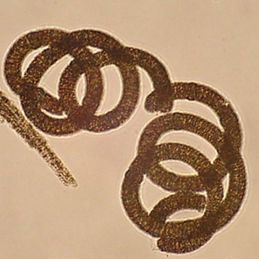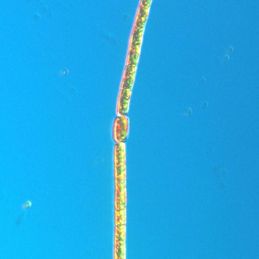
Cyanobacteria are classified as bacteria, but exhibit qualities similar to algae. They thrive when the nitrogen in the water has been used up by the spring bloom and when there is still phosphorus in the water. The cyanobacteria then have an advantage over other algae since they can fix nitrogen from the air.
High water temperature and sunny, calm weather seem to support extra large blooms that are easy to identify. The brackish water species cannot fix nitrogen and do not grow in more marine environments such as in Kattegat and Skagerrak.
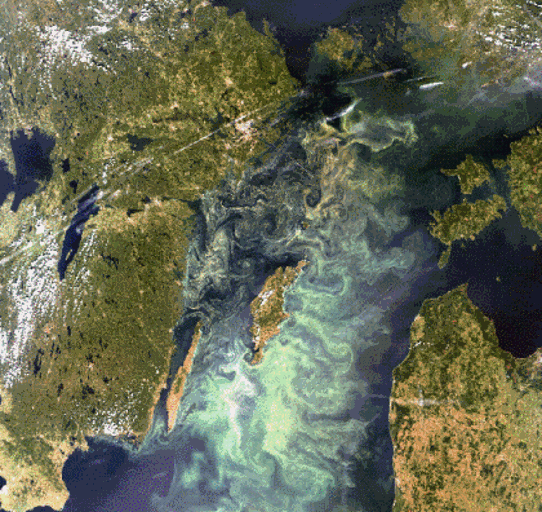
Surface masses of cyanobacteria show up on satellite pictures as yellow-green twisting areas on the sea surface. The white areas in the pictures are clouds and the light blue areas are high clouds which in some cases make the pictures difficult to interpret. Dark blue areas are algae-free water. The pictures have a resolution of 500 m.
The dominant species
There are two main species of cyanobacteria in the brackish waters of the Baltic Sea that bloom during the summer and accumulate on the surface. The dominant species are Aphanizomenon flos-aquae and the poisonous Nodularia spumigena.