Meteorological research and development
At the Meteorology research unit, we are just over forty researchers and specialists with expertise spanning meteorology, theoretical physics and atmospheric chemistry to mathematics and computer science.
We work with observational data, meteorological analyses, and the development of numerical models for regional weather forecasts in the Nordic region, as well as remote sensing, climate analysis, and air quality from urban to global scales. This work is based on knowledge in classical computational systems, numerical modelling, and process understanding, and is guided by a strong commitment to scientific excellence.
Our research and development enhance the scientific basis of numerical models, refine the representation of physical processes in the atmosphere and near the land surface, increase model resolution, and integrate data from new sources. We continuously advance our activities through developments in high-resolution simulations, data assimilation, and digital twins. At the same time, we explore and integrate AI and machine learning methods in areas and processes where they add value.
Our specialists have deep knowledge of various observation techniques and the use of such data, including radar and satellite systems. Our collective expertise contributes to expanding the use of remote sensing data both in model development and in a wide range of meteorological and climatological analyses.

Find on this page
Our research areas give focus and in-depth knowledge
The five research areas focus around questions that bring great benefit to SMHI's operations and society at large:
Atmospheric chemistry and air pollution models
Focus on atmospheric physical and chemical processes
Climate monitoring and research using remote sensing
More climate knowledge from satellite and radar
Nowcasting and remote sensing
New types of data to short-term forecasts

Atmospheric and surface processes
Research for more accurate forecasts

Urban climate and air quality
Heat and air quality in cities
BRIGHT – Advancing knowledge and tools for the adaptation of Swedish cities to heat
Project BRIGHT aims to contribute with new knowledge, optimized methods, enhanced tools and user tailored data that enable Swedish municipalities to better adapt to climate change, with a focus on heat waves. A prototype visualisation platform will be developed that integrates knowledge from high resolution modeling da...
CARRA2 – A new generation Copernicus pan-Arctic regional climate reanalysis
In 2021 Copernicus Climate Change Service released the dataset CARRA1, with a 30-year reanalysis of the Arctic climate (1991-2021). The CARRA dataset is now updated monthly, providing new data with three or fewer months latency. The second phase of the project has started, which will extend the dataset to cover the per...Exploring the transformative potential of climate services
In the research project “Exploring the Transformative Potential of Climate Services,” SMHI researchers will collaborate with a group of researchers from Tema M - Environmental Change and Media and Information Technology at Linköping University to address the future of climate services.GlobAerBiom – Global biomass-burning aerosols and their aging processes: Insights from the modern era satellites
Biomass burning has major impacts on health, climate and society globally. Using satellite data, researchers will now investigate how aerosols from forest and agricultural fires are dispersed and aged in the atmosphere.Satellite-Driven Predictions and Projections of Scandinavian Heatwaves (ScanHeat)
Heatwaves in Scandinavia are becoming more frequent and intense, posing increasing risks to health, ecosystems, infrastructure, and key economic sectors such as agriculture and forestry. The ScanHeat project aims to improve both future climate projections and seasonal forecasts of Scandinavian heatwaves by combining sa...
A important part of our daily work is the development of numerical computational models. We are engaged in research and development to continuously improve these systems through higher resolution, more advanced process descriptions and new data sources.

All of us at the meteorological research unit
The unit is led by Jorge Amorim, together with Patrick Samuelsson and Cecilia Bennet.
We publish our research results in international peer-reviewed journals and in SMHI reports. The two most recent publications from SMHI's meteorological research are:
Quantification of population exposure to NO<sub>2</sub>, PM<sub>2.5</sub>, PM<sub>10</sub> and O<sub>3</sub> and estimated health impacts for 2023 and 2030
Christian Asker, Fredrik Windmark, Mattias Jakobsson, Johan Arvelius, Karolina Siegel, Bertil Forsberg, Johan Sommar
In: RMK, Rapport Meteorologi och Klimatologi
2026
Abstract
A recently developed air quality modelling system is used to produce high-resolution concentrations (with street-canyon effects not included) of air pollutants (NO2, PM2.5,PM10 and O3) over all of Sweden. As a next step the population exposure is quantified and associated health impacts and socioeconomic costs for the years 2023 and 2030 are calculated.
The concentrations of NO2 are predicted to decrease from 2023 to 2030 due to lower traffic exhaust emissions. Modelled exceedances of the air quality standard for the yearly mean of NO2 are limited to the nearest vicinity of a few large roads in 2023, while there are no exceedances for 2030 (excluding street-canyon effects). The average population exposure of NO2 decreases from 4.0 μg/m3 to 2.9 μg/m3.
PM10 and PM2.5 concentrations in 2030 are predicted to remain on a similar level as in 2023, with a possible slight upward trend. The reasons for increasing concentrations are more traffic and thus higher levels of road, tyre and brake wear particles, as well as slightly higher regional background levels. Modelled exceedances of of the air quality standard for the yearly mean of PM2.5 are not expected in neither 2023 nor 2030, while PM10 exceedances are limited to the vicinity of larger roads in both years (again excluding street-canyon effects). The average population exposure of particles shows verylittle variation between 2023 and 2030 (from 8.1 to 8.2 μg/m3 for PM10 and 4.6 to 4.7 μg/m3 for PM2.5).
O3 concentrations are predicted to stay at similar levels in 2030 compared to 2023, with reductions in rural areas and locally increased concentrations close to larger roads. Thethe average population exposure changes only slightly from 57 μg/m3 to 56 μg/m3
The following health impact assessment is based on NO2, local and regional PM2.5, respectively, and wear particles in the PM10 fraction, combining the high-resolution exposure modelling with concentration–response functions from recent epidemiological evidence.
For 2023, the total number of incident mortality cases is estimated at approximately 5 966 (95% CI: 3 905–8 035), with contributions from regional background PM2.5, locally generated PM2.5, wear particles (PM₁₀), and NO2. Compared with previous assessments, the methodology distinguishes more clearly between these sources, including a separate treatment of wear particles using PM₁₀-based risk estimates.
The analysis also includes a broader set of morbidity outcomes. Large numbers of cases are estimated for functional outcomes, including ~680 000 (579 000–782 000) work loss days and ~48 000 (15 700–80 400) school absence days, showing substantial impacts on productivity. Among chronic diseases, estimates include 1 083 COPD cases, 720 dementia cases, 374 diabetes cases, and 251 stroke cases annually. Additional outcomes newly included in the assessment comprise autism spectrum disorder (ASD) (1 422 cases) andallergic rhinitis (148 cases), based on emerging evidence for air pollution effects in children.
In the scenario work for 2030, in total a lower estimated mortality attributed to air pollution was estimated (5 627 cases, e.g. 6% lower), however both of the cases attributed to local wear particles and regional background PM2.5 were higher (621 vs 554 and 3601 vs 3467 cases, respectively).
Methodologically, mortality estimation has been refined by separating PM2.5 into regional background and locally generated components, while wear particles are assessedusing PM₁₀ exposure–response functions. This adjustment addresses the contribution of coarse particles from non-exhaust traffic emissions and avoids underestimation of their health effects, although the uncertainty due to limitations in source-specific risk estimates remains.
Long-term (1990-2023) reanalysis of phytotoxic ozone dose (PODY) for Sweden
Magnuz Engardt, Camilla Andersson
In: RMK, Rapport Meteorologi och Klimatologi
2026
Abstract
We present a long-term (1990-2023) reanalysis of a flux-based metrics describing ozone uptake to vegetation and the associated risk of ozone damage (Phytotoxic Ozone Dose above a flux threshold of Y, PODY). The dataset covers Sweden at 5.5 km × 5.5 km resolution and includes two generic and four specific PODY receptors (POD1gen for deciduous trees, POD1spec for birch and spruce, POD3gen for crops, and POD6spec for potato and wheat). The PODY reanalysis was constructed using the MATCH Sweden System and input meteorology from the Copernicus European Regional Reanalysis system.
PODY, for all receptors, is highest in the south of Sweden and lowest in the Scandinavian mountains. The estimated PODY for birch and spruce are well above the critical levels set by UNECE in practically all of Sweden. For wheat, the critical limits for grain yield and grain weight are exceeded in most of south and central Sweden.
We find no significant trend in PODY in most areas of Sweden, except for central Sweden for generic deciduous trees and birch (negative) and southern Sweden for potato (positive). These changes are, however, likely influenced the introduction of new observation sites in the ozone analyses. Based on the large inter-annual variation of all receptors during the 1990-2023 period we argue that there is little evidence of temporal trends in any of the receptors during the considered period.
To highlight the effects of varying ozone data as input to the PODY calculations we also performed an additional PODY reanalysis using a selection of consistent ozone observations for the period 1990-2013.
New look on interactions between clouds and transpiration by trees in European forests
New research shows a clear link between different cloud types and the transpiration in European forests. An international team of researchers has estimated how changes in cloudiness affect the amount of moisture released by trees into the atmosphere – something that also influences Earth’s water cycle.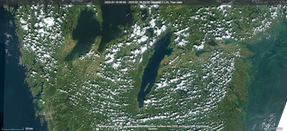
Modelling study shows benefits of reduced ammonia emissions
There are clear benefits for both health and the environment from reducing ammonia emissions. In a modelling study, researchers have estimated the effects of reducing emissions of ammonia and nitrogen oxides, respectively. The results clearly show that reducing ammonia emissions yields the greatest impact, although it ...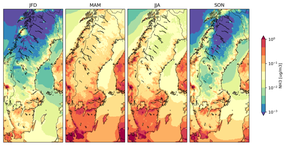
New scientific paper on Sweden’s satellite-based wildfire detection system
For several years, Sweden has used satellites to detect wildfires. Already in the first season, the satellites delivered societal benefits by detecting fires before alerts were raised through other means. A new scientific paper now describes how the system currently operates and how it can be developed further with a n...