
Time to realise the new EPS-Sterna satellite programme
It is time to take Europe’s new satellite programme EPS-Sterna from the drawing board into space. The programme will provide a significant addition of satellite data that SMHI will benefit from in its societally critical work on weather forecasts and warnings, as well as for research.
The first six satellites in the constellation are planned to be launched as early as 2029 and to begin delivering data the following year.
“It is a significant step in EUMETSAT’s history that all member states have now approved EPS-Sterna. It will make us in Europe more independent of Earth observation data from other actors. From a Swedish perspective, we are already looking forward to the first data from EPS-Sterna,” says Håkan Wirtén, Director-General of SMHI and Sweden’s delegate to the European Organisation for the Exploitation of Meteorological Satellites, EUMETSAT.
On Tuesday, the European Organisation for the Exploitation of Meteorological Satellites, EUMETSAT, and the European Space Agency, ESA, signed an agreement that enables ESA to begin procurement for the production of EPS-Sterna.
In a news article on EUMETSAT’s website, Phil Evans, Director-General of EUMETSAT, says:
“This signature turns thirty national commitments into concrete action,” said Phil Evans, Director-General of EUMETSAT. “EPS-Sterna can now move at full speed from planning to hardware, thanks to the strong partnership between EUMETSAT and ESA and the confidence shown by our Member States.”
EUMETSAT and ESA set to start the implementation of EPS-Sterna External link.

Simonetta Cheli (Director of Earth Observation Programmes, ESA) and Phil Evans (Director-General, EUMETSAT) sign the cooperation agreement on EPS-Sterna at a ceremony during the EU Space Conference in Brussels on Tuesday 27 January 2026.
Concept from Arctic Weather Satellite
The EPS-Sterna programme is based on a constellation of small satellites of the same type as Arctic Weather Satellite. This is a Swedish-built mini-satellite, also known as AWS, representing a new type of meteorological satellite. It is small, about the size of a dishwasher, and carries only one instrument: an advanced microwave radiometer. Using this, the satellite measures temperature and humidity in the atmosphere as it travels around the Earth. The data collected are extremely important for the production of weather forecasts and for increasing knowledge of atmospheric processes.
“This is a project that is scientifically very important. Humidity is really a core variable here. Having better knowledge of atmospheric humidity is crucial for all processes related to precipitation, clouds, radiation, and exchanges between land and atmosphere; everything that happens in the boundary layers,” says Abhay Devasthale, research leader for the area climate monitoring and research using remote sensing at SMHI and contact person towards EUMETSAT.
Important in polar regions
EPS-Sterna is particularly important for polar regions, where the constellation will significantly increase the number of satellite overpasses and the volume of satellite data. In just about five hours, the satellites together will observe an area covering 90 percent of the Earth.
 Zoom image
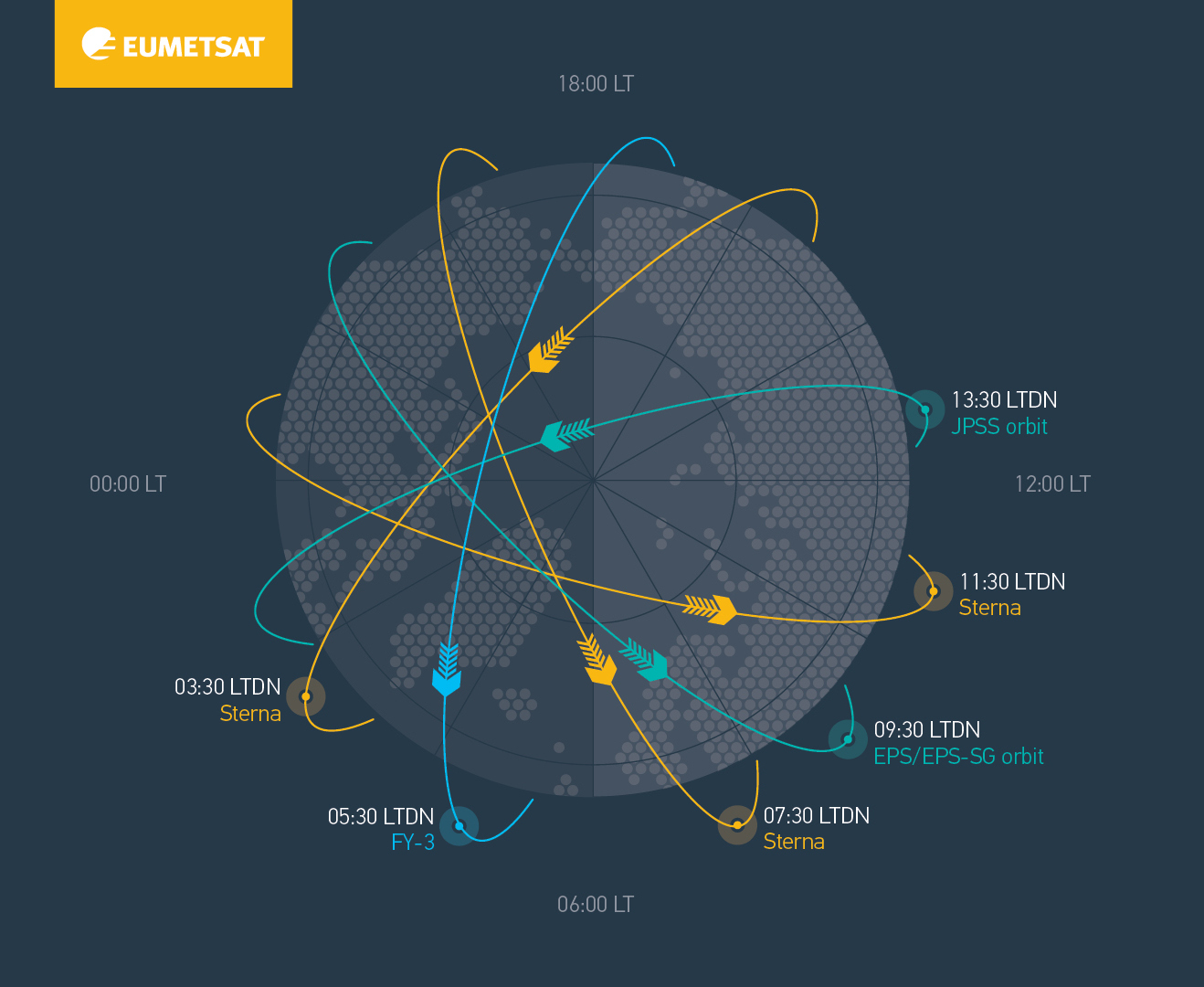
EPS-Sterna, a constellation of six satellites distributed across three polar orbits, complements the satellites in EUMETSAT’s polar satellite programmes EPS/EPS-SG, the United States’ JPSS and China’s FY-3. The times marked with LTDN (Local Time Descending Node) show the local solar time when the satellite crosses the equator on its southbound pass. In just about five hours, EPS-Sterna’s microwave instruments will observe an area covering 90 percent of the Earth.
Impact studies have shown that EPS-Sterna will be able to reduce forecast errors by up to 6 percent across EUMETSAT’s member states, and up to 9 percent in the Arctic region. This provides improved reliability in forecasting severe weather, precipitation intensity and timing, as well as extreme temperatures.
“We have just put an AI tool into operation that improves our precipitation forecasts using satellite data. With the satellites in EPS-Sterna, we will gain more direct observations of precipitation and an increase in data for these analyses. We will have more overpasses over Sweden and over areas where we have fewer surface observations, which is of course an improvement,” says Adam Dybbroe, research leader for the area nowcasting and remote sensing at SMHI.
“With EPS-Sterna, we can also see what is happening in the tropics in relation to humidity, the transport of moisture between the Arctic and the mid-latitudes, and also between the troposphere and the stratosphere,” says Abhay Devasthale.
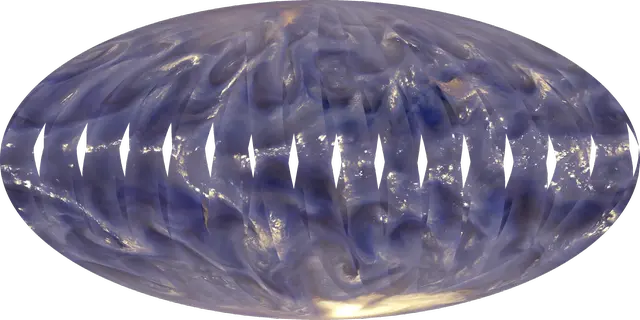
A visualisation of atmospheric humidity from the AWS’ 325 GHz channel, Monday 28 April 2025. The visualisation shows cyclones and convective systems, the weather systems that can cause severe thunderstorms. Using the 325 GHz channels, more areas with thick clouds (white patches) are visible, including outside the tropical regions.
Major projected societal benefits
EPS-Sterna is expected to deliver a strong return on investment from a cost-benefit perspective. Calculations show that EPS-Sterna has a benefit-to-cost ratio of 51, in form of improved weather forecasts that underpin decisions which save lives, increase societal resilience and benefit economies. Overall, this corresponds to a projected economic value of at least EUR 30 billion over the lifetime of the programme.
“We will start seeing the benefits of EPS-Sterna data from 2030. Given the positive experience from AWS and assuming all launches are successful, we will continue to benefit greatly from EPS-Sterna well beyond 2042,” says Abhay Devasthale.
EPS-Sterna
EPS-Sterna is a constellation of mini-satellites of the same type as Arctic Weather Satellite (AWS).
The first six satellites are planned for launch in 2029, where they will work together to monitor the atmosphere.
The constellation will significantly increase the number of satellite overpasses, which is particularly important over polar regions where geostationary satellites have more limited capability. EPS-Sterna will provide near-global coverage every five hours, compared with today’s two overpasses per area per day.
In total, 20 satellites will be manufactured to enable continuous monitoring throughout the programme’s lifetime, from 2029 to 2042.
Arctic Weather Satellite
The Swedish-built mini-satellite Arctic Weather Satellite, also known as AWS, is a new type of meteorological mini-satellite that measures temperature and atmospheric humidity using an advanced microwave radiometer. The microwave radiometer has 19 channels across four different frequency bands (50–57, 89, 165–183 and 325 GHz).
AWS operates in a polar orbit at an altitude of approximately 600 km above the Earth’s surface. The satellite’s smaller size and the fact that it carries only a single instrument have resulted in a short production time and reduced costs.
The satellite was manufactured by OHB Sweden in Kista, and the instrument was built by AAC Omnisys in Gothenburg. It was developed on behalf of the European Space Agency, ESA. SMHI was involved early in the process as a requirements stakeholder, together with the Swedish National Space Agency and the meteorological institutes of the other Nordic countries.
