
CodeBlue – sustainable eutrophication management of the North-East Atlantic Ocean and Baltic Sea
Harmonised ocean data sets for blue sustainable eutrophication management of the North-East Atlantic Ocean and Baltic Sea.
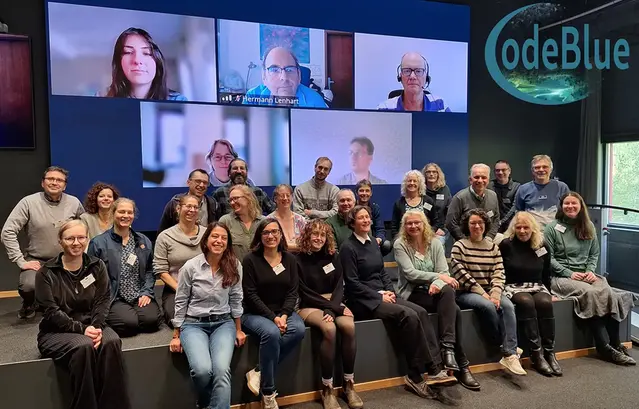
CodeBlue kick-off in Norrköping, Sweden, October 2025.
CodeBlue will address major knowledge gaps in the North-East Atlantic Ocean and Baltic Sea for eutrophication. It will apply an unique biogeochemical forcing to a multi-model approach and test nutrient scenarios under a changing climate. CodeBlue’s main outcome is an open access dataset tailored by and available for regional sea conventions, EU’s framework directives and beyond.
Still a serious problem despite considerable efforts
The most recent assessment reports clearly show that eutrophication remains critical in the North-East Atlantic Ocean and the Baltic Sea. Despite great effort and dedicated work within directives, regional sea conventions and scientific expert groups, knowledge gaps are still significant.
This is not only due to complex links between physical processes, biogeochemical cycles, anthropogenic nutrient loads and inter-basin connections, but also to the lack of a common conceptual approach that combines data within an assessment methodology for the entire North-East Atlantic Ocean and the Baltic Sea.
International action is needed
All countries bordering this area contribute to the nutrient input, especially that of phosphorus and nitrogen. Marine pollution transcends not only national maritime borders, but also regional seas. Therefore, efforts to reduce these compounds must be not only international, but expanded to cover all relevant interconnected basins.
CodeBlue aims to bridge the knowledge gaps
CodeBlue aims to address major knowledge gaps in the entire region that have been already identified for eutrophication. CodeBlue will apply an unique biogeochemical forcing to a multi-model approach co-designed with experts involved in OSPAR and/or HELCOM.
The modelling work covers the North-East Atlantic Ocean and the Baltic Sea and will provide a shared methodology to harmonise results and ensure an inter-comparable solution for the entire region.
CodeBlue’s main outcome is a robust large open access, transparent and harmonised dataset tailored by and available for regional sea conventions, EU’s framework directives and beyond. CodeBlue’s co-design board, the core of the consortium, is composed by key stakeholders representing regional sea conventions, industry and ministries, among others.
Project structure
- WP1 - Compile in situ, remote and model data for model validation and create a unique harmonized biogeochemical forcing
- WP2 - Hindcasts: current state, pre-eutrophication and no-climate
- WP3 - Projections: one climate projection scenario and its twin with nutrient levels fixed at the Maximum Available Input
- WP4 - Harmonized methodology, and policy oriented synthesis
- WP5 - Data management and visualization
- WP6 - 5 local test cases
Key stakeholders in a co-design board ensure that outcomes support decision-making on marine environment restoration and good environmental status
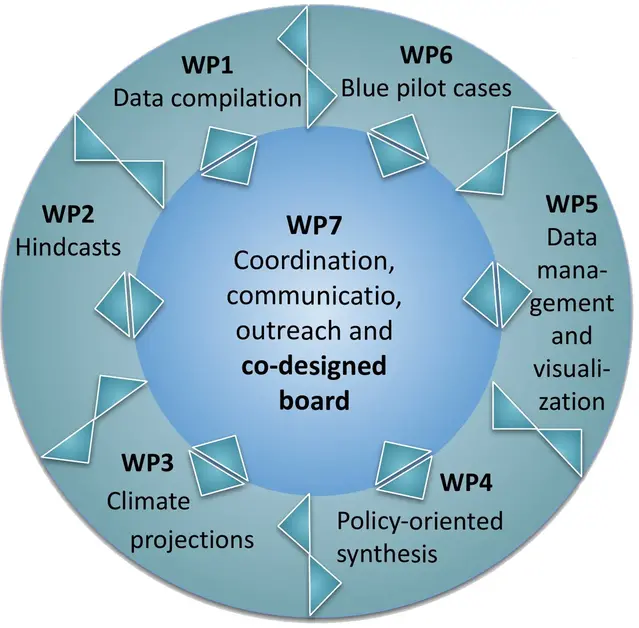
CodeBlue has seven workpackages. The key stakeholders in our co-design board ensure that outcomes support decision-making on marine environment restoration and good environmental status.
News from Code Blue
SMHI leads unique international research project to counteract eutrophication (13 November 2025)
About the project
SMHIs role
SMHI is coordinating the project and leading two workpackages: one which addresses nutrient scenarios under a changing climate and one which in addition to the coordination also manages project communication and dialogues with the co-design board.
Partners
SMHI (coord), ETT, IOW, IMR, MI, +ATLANTIC CoLAB, IEO-CSIC, RBINS, IFREMER, NIOZ, TalTech, Aarhus University, OceanDataLab, SYKE, Aquaecology
Key stakeholders (co-design board)
I&W, Cefas, UBA, HaV, BNI-Stockholm University, Deltares, OSPAR Secretariat, HELCOM secretariat
Project duration
September 2025 – Augusti 2028
Funding
The project is funded by Formas within the transnational call ”SBEP 2024: Unified paths to a climate-neutral, sustainable, and resilient blue economy: engaging civil society, academia, policy, and industry”.
Contacts at SMHI
Elin Almroth-Rosell (coordinator), Itzel Ruvalcaba Baroni, Emilie Breviere
