
SMHI leads unique international research project to counteract eutrophication
Eutrophication remains a serious problem for the Baltic Sea and the north-eastern Atlantic. This affects many marine sectors, such as fishing, tourism and aquaculture. SMHI's oceanographic researchers are leading a major European project which will increase the knowledge needed for sustainable marine management, particularly with regard to eutrophication issues. The first major workshop has now been held, with participants from 14 countries.
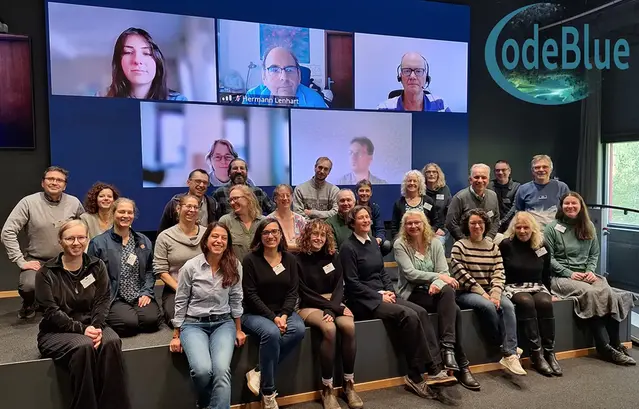
The project's first major workshop, with participants from 14 countries, was held at SMHI's headquarters in Norrköping.
“Too much nutrients in the sea lead, among other things, to plants thriving and then sinking to the bottom where they decay. The decomposition process consumes oxygen in the deep water. The result is oxygen-depleted or completely oxygen-free seabeds where virtually no animals can survive. Those that cannot escape die”, says Elin Almroth Rosell, SMHI, project manager for CodeBlue.
In addition to changes in species composition, i.e. which species and how many of them are found in a particular area, loss of biodiversity, oxygen depletion and death of marine flora and fauna, water quality is generally deteriorating. These problems are largely caused by humans releasing too many nutrients such as nitrogen and phosphorus into the sea.
Digital twin for a more sustainable sea
“Within the CodeBlue project, we will investigate in various ways how the problems of eutrophication in the Baltic Sea and the north-eastern Atlantic are affected by climate change. The results will serve as a knowledge base to help decision-makers find a sustainable way forward in eutrophication policy. In the long run, this would also benefit the blue economy by creating better conditions for various forms of aquaculture, fishing and tourism, for example”, says Elin Almroth Rosell.
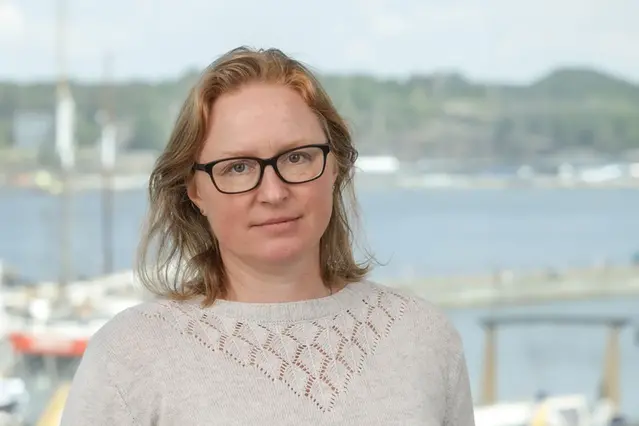
Elin Almroth-Rosell, SMHI, leads the international CodeBlue project. Photo: SMHI/ Niclas Kindahl, Fotofabriken
The project will deliver coordinated methods and sets of model data that answer questions such as ‘What happens if...?’ By developing a digital twin of the sea, which will be available on a user-friendly web portal, entrepreneurs, decision-makers, urban planners and researchers can gain a greater understanding of the marine system and how climate change and human nutrient emissions affect it.
Boundless seas require cross-border cooperation
All countries bordering the Baltic Sea and the north-eastern Atlantic contribute to the inflow of nutrients, especially phosphorus and nitrogen. It is therefore a great success to have brought so many countries together in a single project.
“Since marine pollution spreads both across national borders and to neighboring sea areas, efforts to reduce this pollution must be both international and extended to cover all relevant interconnected sea areas”, says Itzel Ruvalcaba Baroni, researcher at SMHI's oceanographic research unit and leader of work package 3; Climate and nutrient projections.
The starting point for a unique international collaboration
The workshop at SMHI in Norrköping this autumn marked the start of the work. The main focus of the discussions was on three key research questions:
- Has climate change been a significant factor in relation to the increased nutrient supply to the sea in terms of today's eutrophication?
- Will the ‘maximum allowable supply’ of nutrients discussed in international agreements be sufficient to solve the eutrophication problem in a changing climate?
- At the local level: How will the measures implemented affect the blue economy, such as aquaculture and local management in CodeBlue's specific coastal areas?
Sonja van Leeuwen from the Royal Netherlands Institute for Sea Research was in Norrköping:
“Getting to know the other participants better at a workshop like this is a great advantage – as well as learning more about the different perspectives that exist in the various areas. For example, we now have a better understanding of why the regional marine conventions OSPAR and HELCOM's assessments of eutrophication differ and what we need to address. Discussions during the workshop focused on decisions regarding which influencing factors to apply in the scenarios, the advantages and disadvantages of different alternatives and approaches, and the availability of data on the influencing factors”, says Sonja van Leeuwen.
Local stakeholders are also involved
Now the researchers are investigating different methods of producing the data they need for their various models to ensure that they proceed with the best and most suitable methods. At the same time, key local stakeholders within the relevant industries are involved in the project by those who will focus on testing different environmental conditions for these interest groups.
“The whole society will benefit from a project like this”
The project's social impact extends beyond improved water quality and is in line with the UN's sustainable development goals, particularly ‘Oceans and marine resources.
”The whole society will benefit from a project like this, but more in focus are all ocean-related acitivities and professions, such as fishery, aquacultures, shipping, and coastal tourist regions,” says Thomas Raabe, from the AquaEcology institute, Germany.
CodeBlue will run until August 2028. SMHI's part is funded by Formas within the European collaboration ‘the Sustainable Blue Economic Partnership’.
CodeBlue
- project partners and co-design board
CodeBlue has 15 project partners from 14 countries.
Partners
- SMHI, project coordinator, the Swedish Meteorological and Hydrological Institute, Sweden
- +ATLANTIC CoLAB – +Atlantic Associacao Para Um Laboratorio Colaborativo Do Atlantico, Spain
- AE – AquaEcology GmbH & Co. KG, Germany
- ECOS – Aarhus University, ECOSCIENCE, Denmark
- ETT – ETT S.p.A., Italy
- IEO-CSIC – Centro Nacional Instituto Español de Oceanografía - Consejo Superior de Investigaciones Científicas; Spain
- IFREMER – French research institute for exploitation of the sea, France
- IMR – Institute of Marine Research, Norway
- IOW – Leibniz Institute for Baltic Sea Research Warnemuende, Germany
- MI – Marine Institute, Ireland
- NIOZ – the Royal Netherlands Institute for Sea Research, the Netherlands
- OceanDataLab, France
- RBINS – Royal Belgian Institute of Natural Sciences, Belgium
- SYKE – Finnish Environment Institute, Finland
- TalTech – Tallinn University of Technology, Estland
Co-design group
- Baltic Nest Institute – Stockholm University, Sweden
- Cefas – Centre for Environment Fisheries and Aquaculture Science, Great Britain
- Deltares, the Netherlands
- SwAM – Swedish Agency for Marine and Water Management, Sweden
- HELCOM-secretariat
- I&W – Ministry of Infrastructure and Water Management/Rijkswaterstaat, the Netherlands
- OSPAR-secretariat
- UBA – Umweltbundesamt, Germany
