
NBSPLUS – Nature-based solution services promoting local biodiversity, well-being and scalable solutions
Human-induced climate impacts and biodiversity loss severely impact ecosystems and communities globally. Nature-based solutions (NBS) are described to offer cost-effective, multifunctional measures safeguarding biodiversity, enhancing water cycle sustainability and promoting human well-being. Yet, multiple barriers and challenges to the holistic and just implementation of NBS remain. NBSPLUS aims to overcome the limitations of NBS, launching the concept of NBS Services.
Background
Intensified land-use change and climatic extremes all affect the hydrological cycle and thereby water availability, which impacts ecosystems and human well-being. Nature-based Solutions (NBS) are described as highly beneficial for managing social-ecological systems in multiple national and international agreements, and seen as a critical component for developing sustainable societies in a changing climate.
However, there is a clear need for improving NBS – from the design and planning stages through to monitoring and evaluation– to ensure the promise of their multifunctional aspects are realized. Improved NBS implementation is also expected to support just transformative change, while making water resources more sustainable and resilient.
NBSPLUS uses water-centered challenges to develop a suite of transdisciplinary approaches urgently needed to widen the lens from sector-specific, single-risk focused NBS roll-out, to ensure multifunctional, cross-sector measures can be prioritized.
Project objective
The main objective of NBSPLUS is to address the contribution of NBS for just, transformative change and launch the concept of NBS Services.
The project will develop and upscale effective participatory planning for NBS, promoting balanced awareness and consideration of biodiversity, justice and well-being aspects in rural and urban climate resilience planning.
Research questions
- What are the current assumptions and perceptions of decision-makers, which may influence the design and evaluation of NBS performance and thus biodiversity and well-being outcomes?
- How does local awareness and perception of NBS benefits vary across societal groups, and to what extent do they influence the governance capacity to advance climate resilience activities?
- To what extent can novel biodiversity indicators supplement existing NBS knowledge frameworks to facilitate stronger stakeholder engagement in NBS designs?
- How can quantification of synergies and trade-offs in whole-system management be improved to support decision-making and social-ecological resilience to extremes, using NBS?
- How can participatory planning support co-creation effectively for NBS to foster ownership and acceptance and ensure a just transition towards resilience development?
Main activities
NBSPLUS will:
- Develop a multi-level governance framework to assess the aims, effectiveness and social-ecological impacts of NBS;
- Explore the value of novel bioindicators and data collection through citizen science approaches;
- Develop a habitat-overarching biodiversity monitoring framework for assessing the ecological consequences of NBS adaptation;
- Stress-test NBS efficacy through hydrological modelling, to resolve land-use and climate-induced pressures.
- Co-design scalable tools to increase stakeholder engagement in city-to-catchment scale NBS assessments.
NBSPLUS will produce new products and methods relevant for those working with the design, implementation and evaluation of multifunctional and just NBS measures. These will be co-developed for use cases in Sweden, Spain and Canada, demonstrating how NbS services can seamlessly support both new and ongoing NBS implementation efforts.
Key outcomes will be disseminated in the form of guidelines for NBS planning and management, protocols for biodiversity sampling and monitoring, learning modules for how to incorporate NBS Services into participatory planning, as well as a webinar and multi-language policy brief.
Use cases
Riseberga stream, Malmö, Sweden
Challenges and current work
The Riseberga stream is a 12 km long creek running through the eastern part of Malmö, Sweden’s third largest city. It receives a third of Malmö’s stormwater and surface runoff and due to its narrow and deep character, fast water level changes can occur during intense rainfall. This is complicated by heavily impermeable industrial and residential areas. Flooding, erosion and poor water quality are some of the challenges facing the area.
The City of Malmö has established work with both grey and nature-based solutions along the stream, the latter including wetlands, parks and ecological stormwater systems. Projects are ongoing regarding further development and improvement of the area.
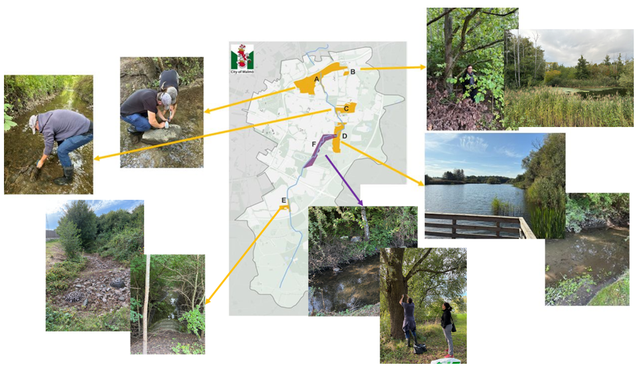
NBS sites along the Riseberga stream.
NBSPLUS will be contributing to ongoing efforts by providing information and tools to support in ensuring that lessons learned from existing NBS measures, in terms of multifunctionality and equitability, can be more easily applied to the design and implementation of new NBS.
Stakeholder engagement meeting in Malmö
Riseberga stream is one of three NBSPLUS case studies. In September 2025 the project group, together with the City of Malmö, hosted its first stakeholder engagement meeting in the city. The aim was to interact with local NBS stakeholders and gain perspectives and feedback for the continued work to enable multifunctional NBS implementation. There were three main activities:
System analysis workshop together with representatives from the City of Malmö
To understand local governance processes enabling and hindering multifunctional implementation of NBS, representatives from Malmö’s municipal office were invited for a workshop. Systems mapping and analysis is an approach to study the structural determinants of NbS implementation processes. This participatory work resulted in several draft causal diagrams that will be further developed and used to support transnational learnings in the project.
Citizen science field testing for evaluating social impacts
Exploring the influence of NBS on human well-being is an important aspect of NBSPLUS – by learning more about how people use and perceive our case-sites, we are able to improve the design and implementation of future NBS. With the help of citizen scientists we tested a social impact survey based on the intersection between biodiversity, social justice and human well-being, at one of the NBS sites along the stream. Testers documented both their own experience of the NBS space, as well as observed how other visitors used the area. After analysing their feedback, a social impact survey for local blue-green space users will be rolled out.
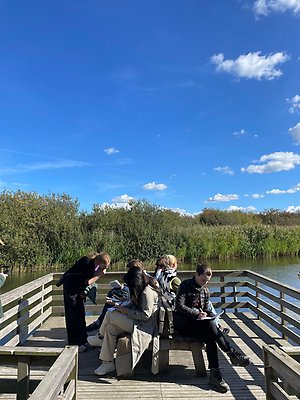
Evaluating the social impacts survey.
Citizen science field activity for monitoring biodiversity
In the project we explore the use of lichens and nematodes as bioindicators in connection to NBS. This includes exploring citizen science methods to evaluate environmental quality through observations of lichen communities, and collection of samples to assess nematode diversity. In Malmö, we tested suggested citizen science approaches with local university students at one of the existing NBS sites along the stream. Before the stakeholder engagement meeting, fieldwork for scientific baseline monitoring of lichens and nematodes was carried out at the site.
Join as a citizen scientist
Locals can support the project and Malmö City as citizen scientist through one or more of the following activities:
- By collecting data on lichens, for example by taking pictures of lichens on trees, describing habitats and evaluating environmental quality following a very simple approach.
- By sampling nematodes.
- As a multiplier for engaging other interested citizen scientists.
The working language is English.
Would you like to support our work or simply to learn more about our activities? You are very welcome to contact:
Dr. Sebastian Höss (hoess@ecossa.de), Institute for Biodiversity–Network (ibn), Regensburg, Germany (nematode expert)
Dr. Luciana Zedda (luciana.zedda@biodiversity-projects.org), Institute for Biodiversity–Network (ibn), Regensburg, Germany (lichen expert)
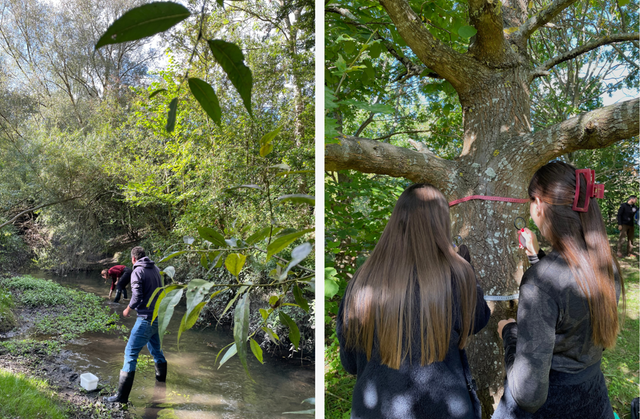
Biodiversity monitoring activities in Malmö. Sampling nematodes (left) and examining lichens (right).
Abrinord Watershed, Quebec Province, Canada
The area faces general challenges regarding degradation of water quality, wetlands, and ecosystem services, as well as streambank erosion, spread of invasive species, and competing or excessive use of water resources.
Ongoing and planned NbS include preserving and restoring wetland ecosystems and shoreline integrity, as well as promoting the use of sustainable forest practices.
NBSPLUS will contribute to these efforts by providing participatory integrated approaches to map and evaluate how NbS can contribute to the diverse objectives of the watershed management plan (social, ecological and economic).
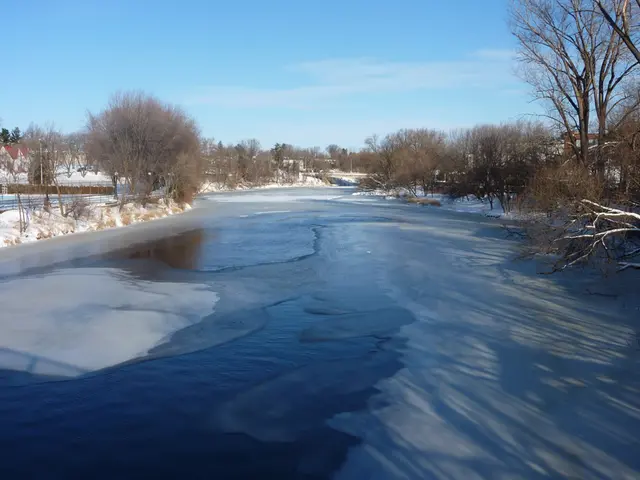
North river in the Saint-Jérôme area, Abrinord Watershed.
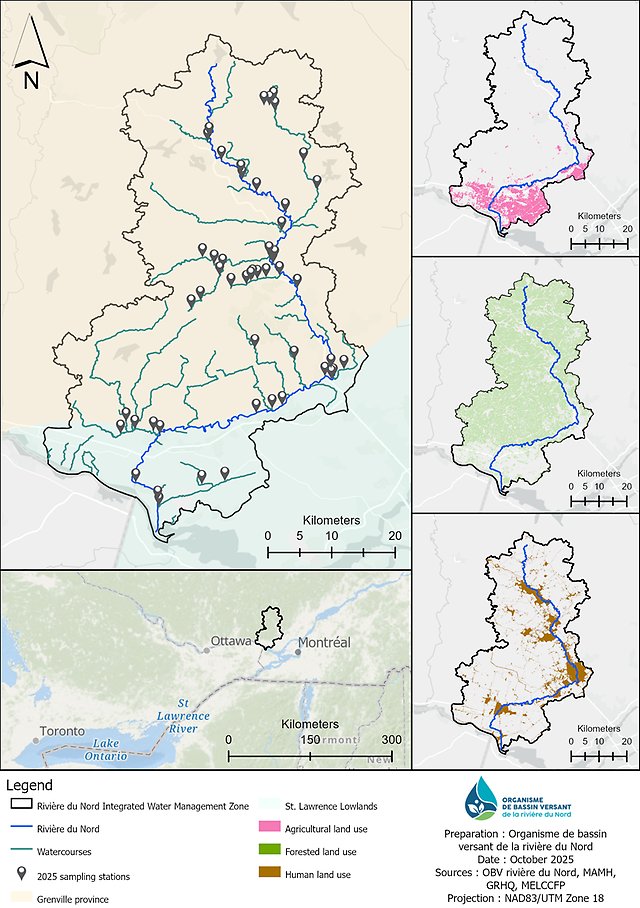
The North river catchment area in Canada, including land use and sampling stations for water quality and water quantity.
Jucar and Turia catchments, Valencia, Spain
Representative of Mediterranean climate with irregular rainfalls and water scarcity issues in spring and summer. These basins are among the most vulnerable, occasionally suffering severe floods and droughts.
To address the issues, sustainable urban drainage systems, constructed wetlands and floodplains have been developed to mitigate flood effects, contributing to increased water security during droughts.
NBSPLUS will help stakeholders and managers to understand the benefits of NbS for mitigating floods, improving groundwater quality, enhancing water security and river biodiversity during droughts, including benefits for well-being and social equity.
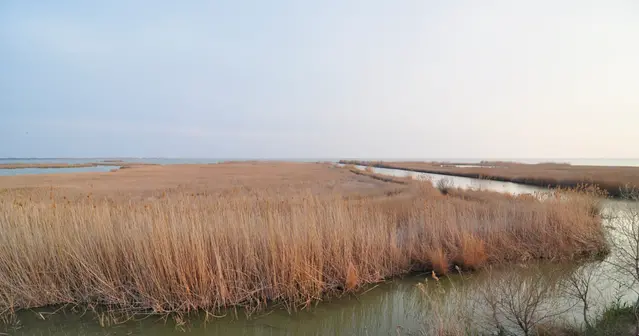
Albufera, an important lake and wetland, located in the Júcar basin near Valencia.
Social Impact Framework for assessing the impacts of NBS on human well-being and justice and its relation to biodiversity
- Nature-based Solutions (NbS) can deliver substantial benefits for human wellbeing and physical health, particularly when intentionally designed and integrated into social contexts.
- NbS should be designed and governed as social-ecological systems, not just as blue-green infrastructure, because social processes are as important as the physical elements in shaping impacts and outcomes.
- Equitable access, inclusive governance, and sensitivity to local conditions are central to successful multi-functional NbS.
- The potential of NbS to maximise wellbeing benefits while maintaining or enhancing biodiversity is context-dependent and requires further research.
- Monitoring and evaluating social impact helps to prioritise actions, demonstrate value, and ensure that NbS contribute to wellbeing, resilience, and fairness over time.
Hydroclimatological data requirements and availability
- Hydrological and hydrodynamic modelling for NbS scenario analysis can be conducted as either long-term or event-based simulations, each with distinct input requirements
- Recommendations and guidelines for hydroclimatological input data vary significantly across and within countries
- Both historical observations and future climate projections are widely available through national services and global datasets
Peer-Reviewed Papers
Implementing systemic nature-based solutions as a cross-sector service for resilient landscapes
In a Perspective, published by Springer Nature in Nature Water, we explore what is needed to design and implement systemic, multifunctional nature-based solutions (NbS) for resilient landscapes.
We contend that NbS interventions must move beyond isolated projects and be implemented as adaptive, measurable services across sectors to deliver lasting benefits for biodiversity and human well-being, while underpinning climate adaptation. Moving beyond so-called 'one-off' projects, often reliant on local ‘NbS champions’, will be essential for creating systemic operating spaces that support accountability, long-term resilience, and just, transformative change.
About NBSPLUS
Project period
December 2024 to 2027.
Financing
The European Biodiversity Partnership Biodiversa+ and Formas, Estonian Research Council, FCT: Foundation for Science and Technology, Government of Spain, Fundación Biodiversidad, AEI: State Research Agency, The Research Council of Norway, Fonds de recherche du Québec.
Contact SMHI
Project lead Ursula McKnight.
Partners
- Swedish Meteorological and Hydrological Institute, Norrköping, Sweden
- Center for Innovation in Territory, Urbanism, and Architecture, Lisbon, Portugal
- Norwegian Institute for Water Research, Oslo, Norway
- Polytechnical University of Valencia, Valencia, Spain
- Stockholm Environmental Institute – Tallinn Centre, Tallinn, Estonia
- McGill University, Sainte Anne de Bellevue, Canada
- Research Institutes of Sweden, Gothenburg, Sweden
- Malmö City, Malmö, Sweden
- Partner and Subcontractor: Institute of Biodiversity Network, Regensburg, Germany
- Stakeholders: Abrinord Watershed Organisation, Quebec, Canada; Confederación Hidrográfica del Jucar, Spain

