
Satellite-Driven Predictions and Projections of Scandinavian Heatwaves (ScanHeat)
Heatwaves in Scandinavia are becoming more frequent and intense, posing increasing risks to health, ecosystems, infrastructure, and key economic sectors such as agriculture and forestry. The ScanHeat project aims to improve both future climate projections and seasonal forecasts of Scandinavian heatwaves by combining satellite observations, climate modelling, and machine learning.
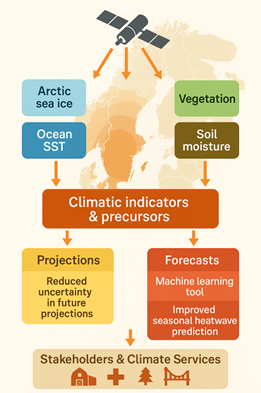
Climate models have struggled to represent the persistence and intensity of Scandinavian heatwaves. This limitation is partly due to an incomplete understanding of internal climate variability and the complex drivers behind these events including changes in the North Atlantic Ocean and Arctic sea ice. By identifying and validating satellite-based climate indicators, ScanHeat will make it possible to better predict how and when extreme heat events develop, and how they might evolve in a warmer future climate.
Objectives
ScanHeat will:
- Identify satellite-derived indicators that influence Scandinavian heatwaves.
- Develop a machine-learning-based seasonal forecasting system using these indicators.
- Improve climate projections by validating heatwave indicators in climate models.
- Collaborate with stakeholders to co-develop impact-oriented tools that support climate services in sectors such as health, energy, agriculture, and forestry.
Approach
Researchers will use the EC-Earth climate model, satellite data on sea surface temperature, sea ice, soil moisture, and vegetation, and advanced signal analysis to separate human-driven trends from natural variability. These results will feed into a probabilistic, physics-informed machine-learning forecast system capable of predicting heatwave risks months in advance.
Partnership and disciplines
ScanHeat brings together expertise from three SMHI disciplines: climate modelling, meteorology, hydrology and remote sensing. The project will also include collaboration with Stockholm University. Additionally, the project will engage different nordic stakeholders.
About the project
Project leader
Dr. Pasha Karami, SMHI Rossby Centre
Funding
The Swedish National Space Agency (Rymdstyrelsen), call Climate and Environment 2025
Project period
November 2025 – October 2027
