
Project continues to strengthen Ethiopia's flood preparedness
The Akaki River flows calmly, and it is difficult to imagine that all the fields around it were flooded as recently as last summer. Flooding is a major problem in Ethiopia – and it will get even worse in a warmer climate. That is why it is important to develop a functioning warning system that can save lives. This is what the WACCA-Ethiopia project is all about. During the latest project meeting in Addis Ababa, several important steps forward were taken.
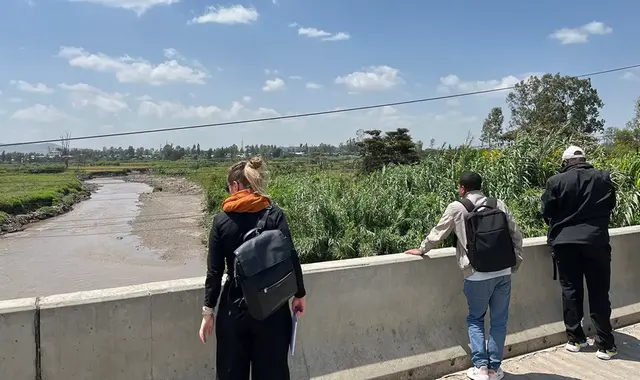
During the summer rainy season, the river's flow can increase rapidly – with devastating consequences.
WACCA-Ethiopia (Water and Climate Change Information Services for Africa – Ethiopia) is run by SMHI and local partners: the Ethiopian Meteorological Institute (EMI), the Ministry of Water and Energy (MoWE) and the Ethiopian Disaster Risk Management Commission (EDRMC).
The project's goal is to build capacity in hydrology and meteorology and to reduce disaster risks. This will be achieved by improving technical knowledge and skills in meteorological, climatological and hydrological services, forecasting and warning systems, and by improve the communication between EMI, MoWE and EDRMC, as well as with the general public.
In October, all partners gathered for a three-day meeting in Addis Ababa, as a continuation of previous work within the project. The programme included both field visits and workshops.
“The meeting was an important step in the work to build a robust and inclusive early warning system for floods. Through cooperation between national, regional and local actors, the value of keeping forecasts and warnings together, transparent communication between organizations and local involvement was highlighted," says Håkan Tropp, project manager at SMHI.
Participants from multiple agencies provide broad support
The meeting brought together participants from different levels of the Oromia Region's flood warning information chain:
- Advisory staff from Oromia's regional and local offices.
- Technical experts from MoWE, EMI and The College of Technology and Built Environment
- Disaster management officials from EDRMC
- Representatives from local community members and disaster risk reduction committees from the Akakis river basin
- Representatives from the Swedish Meteorological and Hydrological Institute (SMHI).
Fayitu Aman, one of the participants, is an expert in early warnings:
“A functioning flood warning system is important for protecting the population from both natural disasters and man-made disasters. Quite simply, it saves lives. Today, we inform about warnings by calling various people in leading positions in society, but they do not always answer. This may be due to network problems, for example. Then we have to call the next person on the list,” says Fayitu Aman.
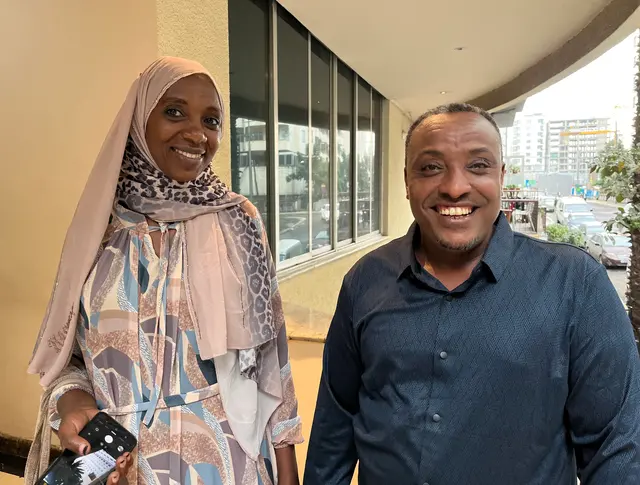
Fayitu Aman and Kedir Aman, experts in early warnings, participated in the project meeting.
Evaluated this summer's test of a new approach to flood warnings
WACCA-Ethiopia is a comprehensive project. The ongoing work focuses on five work packages:
- Improved meteorological information services
- Improved hydrological information services
- Improved communication and action in the event of disaster risk (hydrometeorological forecasts and flood warnings)
- Improved data management and information and communication technology
- Sustainable institutions and cooperation
During the project, all partners have jointly developed a working method to follow when there is a risk of flooding. This is a standardized procedure that begins with meteorologists' forecasts being passed on to hydrologists, who in turn assess the risk of flooding. If there is a risk, the EDRMC is informed, who then disseminates the information regionally and locally. Each step is designed to ensure that the information is easy for the recipient to understand so that the right actions can be taken.
During the rainy season this summer, the pilot was tested in a real-life situation in a limited area: the Akaki river basin in the Oromia region. It was this test period that was evaluated during the three days in Addis Ababa.
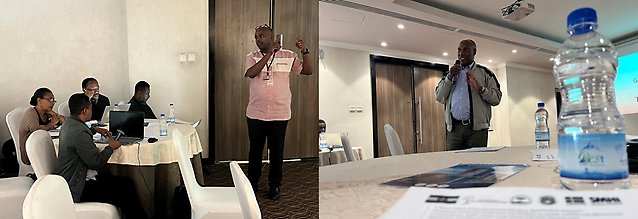
The workshops featured many constructive discussions and interesting presentations. On the left: Tharcisse Ndayizigiye from SMHI, and on the right: Tibebu Kumsa from EDRMC's regional office in Oromia.
Among other things, the design, implementation and results of the pilot campaign, the accuracy of the forecasts, the effectiveness of the communication protocols and recommendations for how the system can be improved and scaled up were discussed.
Constructive discussions that take the project forward
The group discussions showed that the participants agree on the need to find a balance between effective work, available resources and the capacity of the organizations. There is also clear agreement on the importance of planning ahead, having clear procedures for when measures should be stepped up and improving coordination between EMI, MoWE and EDRMC. This will ensure that weather and flood services continue to function even during periods of extreme weather.
“We made use of everyone's experience and discussed how the work can be developed in the future”, says Tharcisse Ndayizigiye, project manager for work package three, Improved communication and measures in the event of disaster risk, who continues:
“It is important that we support the participants in feeling a sense of ownership over the products so the working method will be sustainable in the long term. They need to be prepared to take over when the project period is over – and we are definitely on our way there.”
Expanded testing next year
Håkan Tropp concludes:
“The experience gained from the pilot project during Ethiopia's 2025 rainy season will now form the basis for further expanded testing during the 2026 rainy season. The collective project experience will now be used as a basis for a possible next phase of the WACCA-Ethiopia project and serve as a model for how the early warning system can be developed and used throughout the country”.
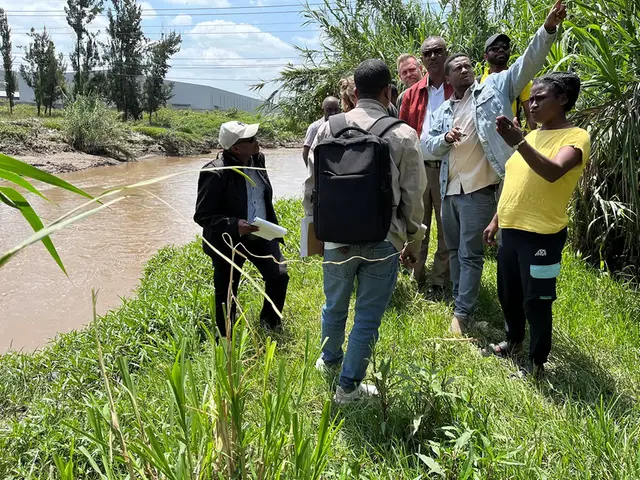
During a field visit to a hydrological station on the Akaki River, the participants met Lewednesh Guramu, who works at the station and reads the water level. They discussed data collection and comparisons between observations and forecasts.
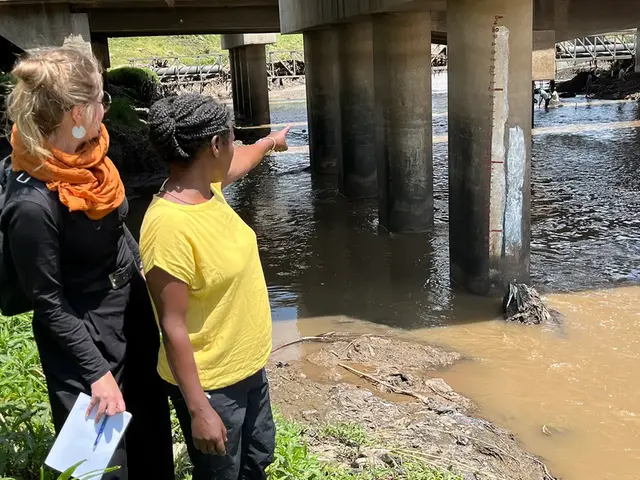
Lewednesh Guramu shows the hand-painted gauge, the water level meter, which she reads manually during the rainy season. She enters the observed values in a register that is submitted to MoWE approximately once a month.
WACCA-E
WACCA-E stands for Water and Climate Change Information Services for Africa - Ethiopia. Together with local partners – the Ethiopian Meteorological Institute (EMI), the Ministry of Water and Energy (MoWE) and the Ethiopian Disaster Risk Management Commission (EDRMC) – SMHI is running the WACCA-Ethiopia project. The project's goal is capacity development in Ethiopia's hydrology, meteorology and disaster risk reduction.
The goal will be achieved by improving technical knowledge and skills relating to meteorological, climatological and hydrological information services, forecasts and warning systems, and by developing communication between the various authorities – and with end users.
The first phase of the project ran from 2018 to 2022. Phase 2 started in 2023 and will run until 2026. The project is funded by the Swedish International Development Cooperation Agency (Sida).
