
New insights into clouds and climate change in the Amazon region
A new scientific article provides important insights into how clouds are linked to land surface changes and to natural variability in the Amazon region. At the same time, it highlights how challenging it is to study the connections between different climate variables in the Amazon. The article originates from a master’s thesis conducted in collaboration between Stockholm University and SMHI.
The importance of the Amazon rainforest is best expressed in numbers. It is the world’s largest tropical rainforest, hosting at least 10 percent of all terrestrial biodiversity and storing the equivalent of up to 20 years of global anthropogenic carbon dioxide emissions. The Amazon contributes roughly 20 percent of the world’s freshwater. The moisture from evapotranspiration in the forest accounts for nearly 50 percent of the regional precipitation.
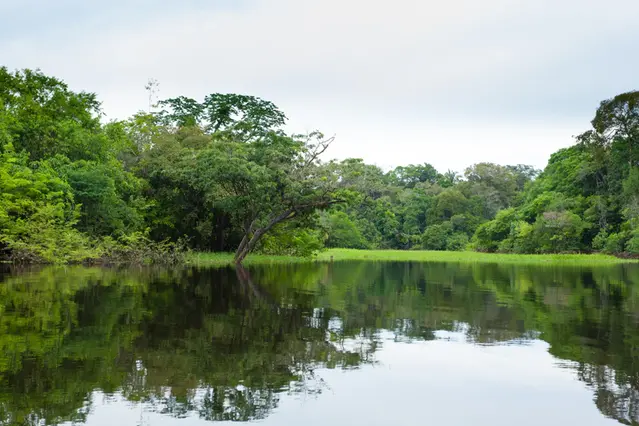
Wetlands in the Brazilian part of the Amazon.
It is therefore not surprising that various aspects of the Amazon climate are being intensively studied, including the changes that could challenge the resilience of the forests and push them toward a tipping point.
Understanding the role of clouds
“We still know very little about how clouds are changing in the Amazon and whether they play a role in climate feedbacks there,” says Abhay Devasthale, research leader at SMHI’s meteorological research unit and associate professor at the Department of meteorology, Stockholm University (MISU).
Fride Wilhelmsen Næss, then a student at MISU, took up the challenge to study clouds in the Amazon for her master’s thesis. During 2024, she completed both her master’s thesis and a subsequent summer project at SMHI.

Fride Wilhelmsen Næss
Changes in cloudiness may accelerate warming
Using satellite products such as the CLARA-A3 dataset, Fride Wilhelmsen Næss identified interesting trends in Amazonian cloudiness. In the northern parts of the Amazon, where the forests are very dense, high clouds are increasing during the rainy season. This trend is linked to temperature variability in the Pacific Ocean (El Niño–Southern Oscillation) and moisture transport from the Atlantic.
However, the opposite is happening over southern Amazonia. During the dry season, low clouds are decreasing, which is associated with deforestation and a drier climate. These changes indicate potentially positive feedbacks that could accelerate warming in the Amazon by affecting surface solar radiation – changes that Abhay finds concerning.
Feedback mechanism
A positive feedback is a reinforcing mechanism – a process in which a change in a system leads to additional changes that amplify the initial effect. Positive feedbacks often result in consequences that are considered negative for life on Earth.
Source: Swedish Term Bank for Sustainability, Institute for Language and Folklore.
“This study is scientifically very interesting and also highlights the typical trends that hydroclimatic systems undergo under anthropogenic climate change – wet regions becoming wetter and dry regions becoming drier. What happens in the Amazon is crucial for the global climate, and Fride has shown some intriguing trends suggesting a negative impact of land-use change on clouds and, consequently, on the climate,” Abhay emphasizes.
“It has been very rewarding to work on such an exciting and important topic as the Amazon. At the same time, it is worrying to see in numbers how climate change and deforestation are affecting the rainforest. Although the study provides indications of ongoing processes, there is still much we do not know – for example, how these changes in clouds will affect both local and global climate through feedbacks. I hope our results can serve as motivation for further studies on deforestation, its impact on clouds, and potential feedback mechanisms,” says Fride Wilhelmsen Næss.
 Zoom image
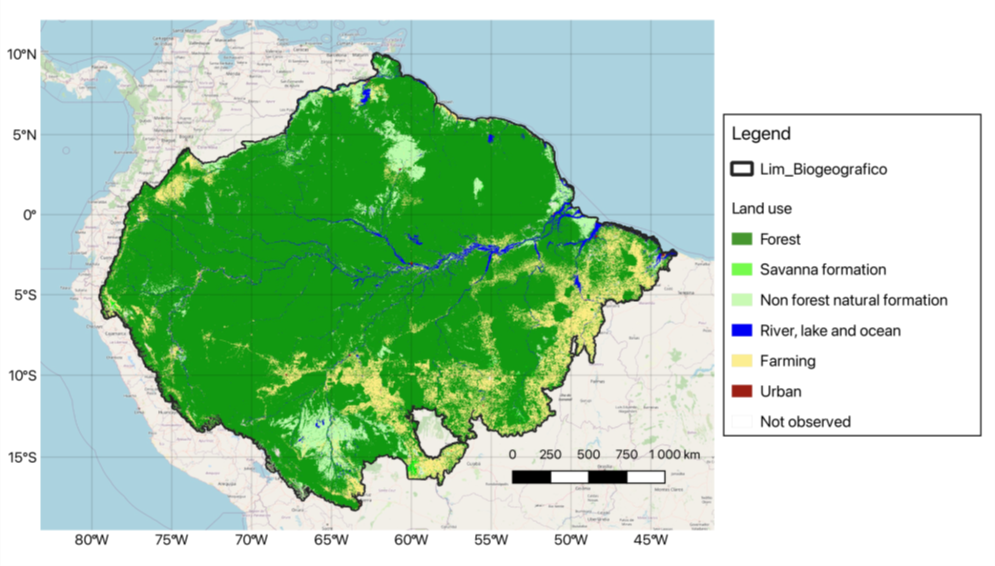
The figure shows the study area with an overview of land cover types. Geographical boundaries are from the Amazon Network of Georeferenced Socio-Environmental Information (RAISG), while land cover types and colors in the legend are from MapBiomas Collection 6.
Abhay Devasthale was Fride’s main supervisor for the thesis, while MISU Professors Annica Ekman and Abdel Hannachi served as co-supervisors.
Read the scientific paper in Journal of Climate
Næss, F. W., A. Devasthale, A. M. Ekman, and A. Hannachi, 2025: A climatological perspective on trends and variability of cloudiness over the Amazonian basin during the last decades. J. Climate, https://doi.org/10.1175/JCLI-D-24-0747.1 External link., in press.
PhD studies focused on the Arctic
Fride Wilhelmsen Næss has now started a PhD position at MISU, where she will work on a project studying the role of clouds in the Arctic climate.
“Combining the thesis between MISU and SMHI worked very well, and it was great to continue the exciting work during the summer. That experience, combined with the strong support from my supervisors, probably motivated me to continue with a PhD,” concludes Fride.

