
Cleaner air and less cloud cover increase the potential for solar energy
By studying changes in surface solar radiation and cloud cover, researchers have found that the potential for producing more solar energy has increased. The increase is strongest in April and June in Sweden and in large parts of Europe. The results are published in a scientific journal as a ‘Highlight paper’.
The share of renewable energy, including solar energy, is increasing in Europe. The European Green Deal is paving the way for a faster transition to clean energy. To facilitate a more efficient transition to renewable energy, an understanding of past and future climate change is required.
April and June stand out
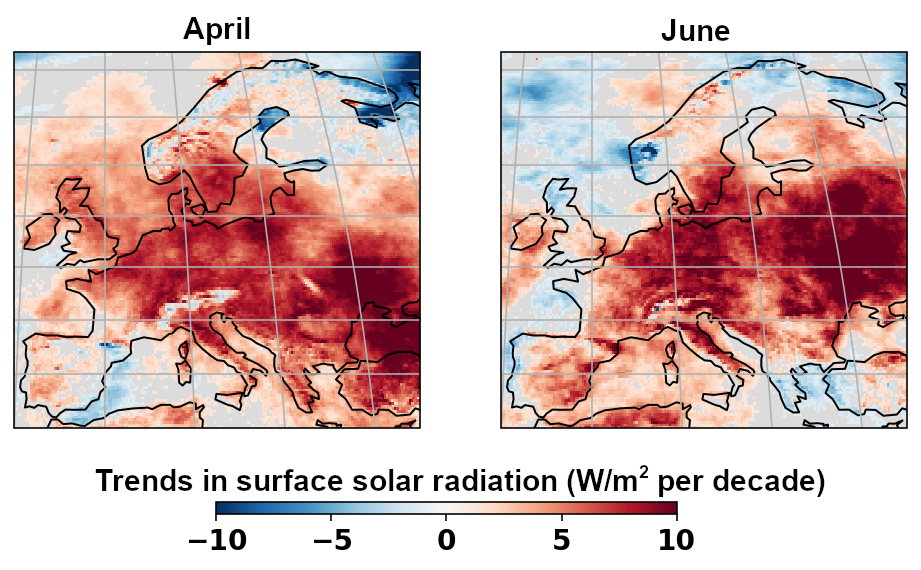
In a collaboration between European weather services, SMHI has led a group of researchers who have analysed changes in surface solar radiation and cloud cover over Europe. After analysing satellite data from the last 40 years, they have found that surface solar radiation has increased significantly over large parts of Europe during the months of April and June. The increase is particularly large in central and eastern Europe and southern Scandinavia. This is mainly due to a significant decrease in cloud cover during these months. These changes are also observed to some extent in March.
“The changes mean that conditions for solar energy have become more favourable during the spring and early summer,” says Abhay Devasthale, research leader in climate monitoring and remote sensing research at SMHI, who led the study.
 Zoom image
The maps show how the amount of surface solar radiation has changed during the months of April (left) and June (right) since satellites began measuring this in the early 1980s (1982-2020). A redder colour scale indicates an increase in the amount of radiation, which is significant across large parts of Europe, especially in central and eastern Europe and southern Scandinavia.
The study was published in the EGU journal Earth System Dynamics, where it was selected as a Highlight Paper.
Cleaner air matters
The results of the study clearly show how increased surface solar radiation due to cleaner air and fewer clouds affects Europe's climate. Long-term changes in a number of factors in the atmosphere, such as aerosols, clouds, water vapour and ozone, affect how much solar radiation reaches the ground.
“One of the main messages from this study is that changes in clouds are now playing an increasingly important role and will continue to do so in the future. This is mainly because concentrations of pollutants and aerosols have decreased significantly in Europe in recent decades, thanks to EU clean air legislation,” says Abhay Devasthale.
“It is important to monitor what happens to the surface solar radiation over the long term in order to understand how humans affect the climate in various ways. Future studies may examine in more detail how this has affected conditions at ground level, such as soil moisture and snow cover, which in turn may have contributed to amplifying warming,” says Erik Kjellström, professor of climatology at SMHI.
Clouds in climate models
However, the increasing importance of changes in clouds poses a number of challenges. Today, data from climate models is used in the design of solar energy parks, but simulations from current climate models show very large uncertainties in future regional changes in clouds and their properties. These uncertainties are reflected in the spread of surface solar radiation in the energy budget, a spread that can vary by several watts per square metre between different climate models.
“Monitoring surface solar radiation and clouds using satellite data is therefore particularly useful, as it can provide information about the observed state of the climate and trends in various climate variables, which can also be used to predict surface solar radiation in the coming years,” explains Abhay.
Such mapping is also useful for retrospectively evaluating decisions made based on data from climate models.
Increased usability of the CLARA-A3 dataset for climate research
Within the framework of EUMETSAT's Satellite Application Facility on Climate Monitoring (CM SAF), SMHI has been deeply involved in the development of the CLARA-A3 dataset, on which this survey is based, for the past 25 years. This dataset now offers several opportunities to conduct high-quality climate research, thanks to increased accuracy, maturity and the length of the dataset over the years.
The results of this study demonstrate the value of long-term investments in satellite-based climate monitoring, in this case with a focus on clouds, which are becoming increasingly important to monitor.
The study also shows the importance of long-term ground measurements of solar radiation in Sweden and Europe. These measurements are regularly used to validate and evaluate the satellite data products.
The study on changes in surface solar radiation was partly funded by the Swedish Research Council (2021-05143) and partly by the national climate adaptation grant to Swedish authorities, 1:10 (2023).
