
Camilla Andersson
Docent in meteorology, Ph D in environmental Science, Senior researcher in Air Quality. Swedish focal point in IPCC.
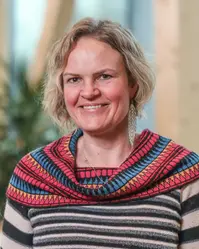
Camilla Andersson
Field of work
Hemispheric-regional-urban scale dispersion model development and application, including:
- Aerosol dynamics
- Near-surface ozone
- Nitrogen and sulphur deposition
- Environmental and exposure mappings and scenarios
- Data assimilation and reanalyses
- Air-quality and climate change couplings
- Impacts of air pollution on human health and the environment
Research interests
- Hemispheric, regional and urban air quality
- Health and vegetation exposure modelling to near-surface ozone, aerosols and deposition of acidifying and eutrophying species
- Scenarios and mapping of past, present and future conditions
Special competences
Research leader, research programme coordinator and work package leader, researcher, developer, expert adviser, scientific programmer
Long-term (1990-2023) reanalysis of phytotoxic ozone dose (PODY) for Sweden
Magnuz Engardt, Camilla Andersson
In: RMK, Rapport Meteorologi och Klimatologi
2026
Abstract
We present a long-term (1990-2023) reanalysis of a flux-based metrics describing ozone uptake to vegetation and the associated risk of ozone damage (Phytotoxic Ozone Dose above a flux threshold of Y, PODY). The dataset covers Sweden at 5.5 km × 5.5 km resolution and includes two generic and four specific PODY receptors (POD1gen for deciduous trees, POD1spec for birch and spruce, POD3gen for crops, and POD6spec for potato and wheat). The PODY reanalysis was constructed using the MATCH Sweden System and input meteorology from the Copernicus European Regional Reanalysis system.
PODY, for all receptors, is highest in the south of Sweden and lowest in the Scandinavian mountains. The estimated PODY for birch and spruce are well above the critical levels set by UNECE in practically all of Sweden. For wheat, the critical limits for grain yield and grain weight are exceeded in most of south and central Sweden.
We find no significant trend in PODY in most areas of Sweden, except for central Sweden for generic deciduous trees and birch (negative) and southern Sweden for potato (positive). These changes are, however, likely influenced the introduction of new observation sites in the ozone analyses. Based on the large inter-annual variation of all receptors during the 1990-2023 period we argue that there is little evidence of temporal trends in any of the receptors during the considered period.
To highlight the effects of varying ozone data as input to the PODY calculations we also performed an additional PODY reanalysis using a selection of consistent ozone observations for the period 1990-2013.
Highly resolved projections of climate and vegetation indicate major changes in northern Scandinavia
Hakan Pleijel, Fredrik Lagergren, Erik Kjellström, Petter Lind, Paul A. Miller, Robert G. Bjork, Tinja Olenius, Danijel Belušić, Mats P. Bjorkman, David Lindstedt, Gunhild Rosqvist, Camilla Andersson
Kilometre-scale simulations over Fennoscandia reveal a large loss of tundra due to climate warming
Fredrik Lagergren, Robert G. Bjork, Camilla Andersson, Danijel Belušić, Mats P. Bjorkman, Erik Kjellström, Petter Lind, David Lindstedt, Tinja Olenius, Hakan Pleijel, Gunhild Rosqvist, Paul A. Miller