
SMHI contributes to research school on AI
SMHI contributes to the ELLIS Winter School 2026 on “AI for Earth System, Hazards & Climate Extremes” that takes place on March 16–20, 2026, in Athens, Greece. The research school is hosted by the National Technical University of Athens (NTUA) and organised by the research projects MeDiTwin and AI4PEX.
This five-day, in-person and hands-on programme brings together leading experts and early-career researchers to explore the latest advances in artificial intelligence for extreme event analysis. The school combines theoretical lectures, practical training, and real-world applications aimed at improving modelling, understanding, and impact assessment of Earth system processes, natural hazards, and climate extremes.
– Hopefully, it will be a valuable week for both the organisers and participants. The topic of the school is very relevant, and we noticed that there was huge interest when early-career researchers from around the world applied to participate, says Miranda Gatti Ståhl, communication officer at SMHI and part of the organising team.
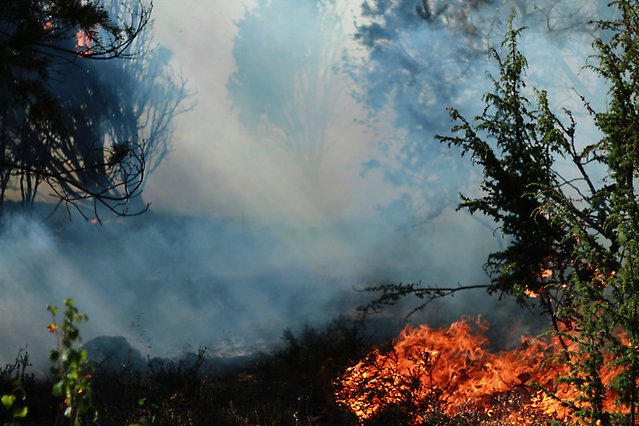
Extreme weather events causing wildfires will be studied during the research school.
Keynotes and Expert Contributions
The programme features keynote talks by internationally recognised researchers in AI and Earth system science, offering strategic perspectives on emerging methods and real-world challenges. The programme is structured around four pillars: data, modelling, trustworthiness and communication to give participants the best entry point into the subject.
From SMHI we are especially pleased that Ramón Fuentes Franco, climate researcher and researcher leader, and Mikhail Ivanov climate researcher, will join. Ramón will join as key note speaker and talk under the title “Learning from Variability: AI insights into Extreme events”, while Mikhail will join as a challenge tutor.
– I expect the winter school to be a great opportunity for exchange and discussions between researchers working at the intersection of climate science, Earth observation, and artificial intelligence. For me, it will be particularly valuable to interact with early-career scientists, and discuss, among other things, how machine learning methods can be used to model extreme climate events. I am also looking forward to learning about new approaches and applications of AI in Earth observation, and to building collaborations that can strengthen future research in climate variability and extremes, says Ramón Fuentes Franco.
– I look forward to meeting the students and helping them tackle the challenge. We have prepared a challenge that reflects the research questions we aim to answer ourselves, and it is always insightful to explore these questions together in such an interactive and hands-on way, says Mikhail Ivanov.
Strong Interest and Inspiring Participant Experiences
The school attracted strong international interest and a high number of applications, reflecting the growing importance of AI in addressing climate extremes and natural hazards. About 90 students were excepted and will meet this week in Athens.
Beyond the academic programme, social activities will foster networking and collaboration, creating a dynamic environment for exchange between the participants as well as the organisers.
For more information, visit the official event page (meditwin-project.eu). External link.
