
Strengthened research cooperation between SMHI and Brazil
SMHI has maintained an active research collaboration with Brazil since 2018, focusing on issues such as urban heat and air quality. Last autumn, several meetings were held to establish new research collaborations in additional areas, including environmental and water-related issues as well as climate information.
During the autumn, several SMHI staff members visited Brazil to continue existing collaborations and initiate new ones.
Nordic–Brazilian dialogue ahead of and beyond COP30
The visits began with the meeting “Bridging Knowledge for Science with Impact in the Amazon – Nordic–Brazilian Dialogue Toward and Beyond COP30”. The aim was to strengthen cooperation and exchange knowledge on research with an impact on the Amazon region in Manaus ahead of and beyond COP30.
Over three days, researchers, policymakers, research funders and other stakeholders from both the Nordic countries and Brazil gathered to discuss current research and collaboration on climate, biodiversity and sustainable development, and how research results can contribute to societal impact.
– The workshop focused a great deal on Indigenous peoples in Brazil. They are particularly vulnerable when it comes to deforestation, declining fisheries and water pollution, among other issues. Their representatives are also often excluded from decision-making processes and their knowledge is overlooked. There are clear parallels with the Sámi people in the Nordic countries and the conflicts of interest that arise around forestry, industry and the extraction of minerals and metals. We also saw several good examples where new approaches have been developed, says Iréne Lake, International Project Manager at SMHI.
The meeting resulted in a policy brief, which will be published in Portuguese and English, with Iréne Lake as one of the co-authors.
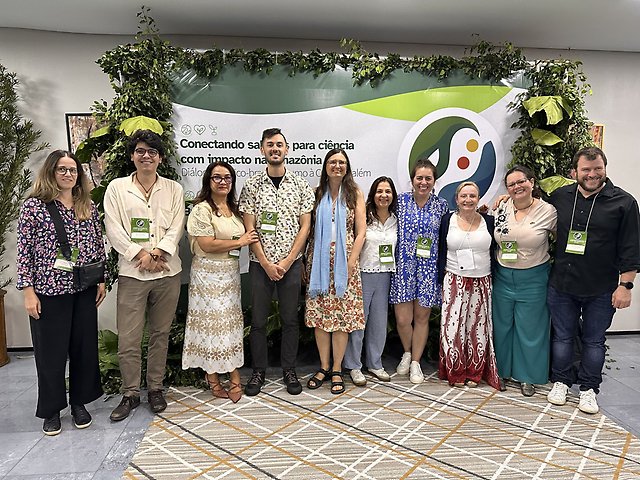
The Swedish delegation at the meeting in Manaus, Brazil.
Environmental and water issues in Fortaleza
After the meeting in Manaus, Alena Bartosova (hydrology researcher and group manager at SMHI) and Conrad Brendel (hydrologist at SMHI) travelled to Fortaleza to take part in meetings with the city administration, the Swedish Environmental Protection Agency and IVL Swedish Environmental Research Institute.
The meeting was held at the headquarters of the Secretariat for International Relations in Fortaleza and included participants from several municipal departments, including civil defence, environmental protection and public services; urban planning and environment; the Fortaleza Institute for Planning and Research; and the city’s regulatory agency for environmental sanitation services.
Later, the Swedish delegation also met with universities and institutes focusing on water management and environmental issues. This resulted in a cooperation agreement with a university in Fortaleza (UNILAB).
During the meeting, the various departments presented the measures the city has developed to prevent risks and promote sustainability in urban areas.
– We hope to exchange many ideas and experiences between Sweden, the state of Ceará and the municipality of Fortaleza through this collaboration. We began this dialogue two years ago when the Swedish Environmental Protection Agency invited us as experts in water management and water quality. We have much to learn together about water scarcity and drought, as well as flooding, says Alena Bartosova.
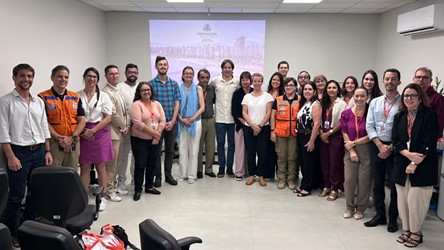
The meeting brought together different municipal departments in Fortaleza, SMHI, IVL and the Swedish Environmental Protection Agency. Photo: City of Fortaleza.
Continued engagement for climate-adapted cities
Isabel Ribeiro, meteorology researcher at SMHI, arrived in Fortaleza the week after her SMHI colleagues to continue work on green infrastructure, thermal comfort and air quality together with the city and the Federal University of Ceará.
This work, which is part of the city’s climate adaptation efforts, has been ongoing since 2018 and was initiated by Jorge Amorim, researcher and head of unit at SMHI.
The projects resulting from this collaboration, as well as the visits, are funded by the Swedish Environmental Protection Agency and have engaged several PhD students from universities in Fortaleza.
– It is very encouraging to see that there is still strong engagement in this collaboration and that it continues to deliver results. Most recently, one of the doctoral theses has contributed to a so-called master plan addressing thermal comfort and vulnerability issues in Fortaleza, says Isabel Ribeiro.