
A strategic tripartite partnership to improve flood forecasting in West Africa and the Sahel
The United Nations Development Programme (UNDP), the AGRHYMET Regional Climate Center for West Africa and the Sahel (AGRHYMET CCR-AOS) of the Permanent Interstate Committee for Drought Control in the Sahel (CILSS), and the Swedish Meteorological and Hydrological Institute (SMHI) have established a strategic tripartite partnership aimed at enhancing the accuracy and sustainability of flood risk forecasting in West Africa and the Sahel.
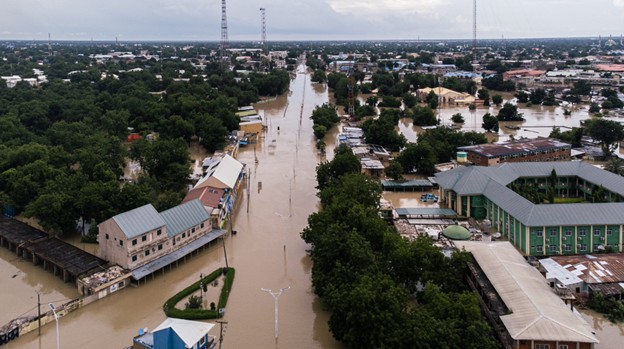
Floods in Maiduguri, Nigeria, 2024. Source: @WFP_Nigeria
This pioneering collaboration combines SMHI's scientific expertise and research, AGRHYMET CCR-AOS's regional forecasting capacity, and UNDP's role as a knowledge broker, capacity developer, and facilitator of exchanges to generate reliable data and analysis for informed decision-making to prevent and manage hydrological, climatic, and environmental risks.
Commending the strategic partnership, UNDP’s Director of the Sub-Regional Office West and Central Africa and Resident Representative for Senegal, Njoya Tikum said: This partnership is a key milestone toward a more resilient Sahel, bringing technology, science, and international cooperation together to better protect communities from climate change impacts.
He highlighted that UNDP is bridging science, policy, and decision-making to ensure climate knowledge translates into action on the ground.
“Through the Sahel Resilience Project, we are strengthening institutions for disaster risk reduction and adaptation, co-creating inclusive solutions, and supporting communities to better anticipate and respond to hydrometeorological hazards, while localizing advanced flood forecasting and early warning systems,” Njoya Tikum noted.
Over the past two years (2024-2025), catastrophic floods have affected at least 16 countries in West and Central Africa, impacting more than 8,5 million people. The hardest-hit countries include Niger, Nigeria, and Chad, where material damage and human losses have been particularly severe. This situation follows more than a decade of increasing flood-related challenges in the region.
Together, the three organizations are committed to developing effective and sustainable early warning systems based on science and innovation, in order to save lives, protect livelihoods, and anticipate increasingly frequent extreme hydrometeorological conditions.
“The AGRHYMET CCR-AOS Center holds a strategic position within the CILSS framework to strengthen climate resilience in the Sahel and West Africa. Our sustained cooperation with SMHI and UNDP perfectly illustrates our shared commitment to accelerating innovation, modernizing climate services, and providing member states in the region with reliable tools for risk anticipation. Together, we are building a partnership that reinforces disaster risk reduction, food security, and sustainable development in our region", says Dr. Abdoulaye Mohamadou, Executive Secretary of CILSS.
Through this partnership, SMHI, AGRHYMET CCR-AOS, and UNDP aim to migrate the FANFAR system from Europe to Africa. This represents a major advancement in strengthening regional flood forecasting capacities and hydrometeorological risk management. Since 2018, a European and African consortium led by SMHI has designed and developed an operational flood forecasting system tailored to the context of the Sahel and West Africa. The system has been operational since then and has contributed to saving lives and property on numerous occasions, for example, in Nigeria in 2020 and in Côte d'Ivoire in 2022. The transfer to Africa is expected to follow a progressive and collaborative approach, focused on co-development, knowledge transfer, and regional ownership.
Website of the FANFAR system (fanfar.eu) External link.
“SMHI is delighted to continue this long-term collaboration with AGRHYMET CCR-AOS and the broader West Africa and Sahel region. This phase represents a key step in enabling the region to autonomously produce and communicate hydrological forecasts and alerts. With the effective commitment of all stakeholders to their respective roles in ensuring the system's sustainability, improvement, and utilization, FANFAR holds strong potential to save more lives and property in the region", says Dr. Jafet C. M. Andersson, Senior Researcher, Coordinator of International Development Cooperation, and Project Manager at SMHI.
Main steps in the process

Design and experimentation phase in Sweden – The hydrological model HYPE was initially developed and tested in Sweden, with scientific and technical support from several research institutes and the Swedish International Development Cooperation Agency. It integrated satellite data, hydrological models, and visualization tools to improve forecast accuracy.

Adaptation to the West African context – Through close cooperation between SMHI, AGRHYMET CCR-AOS, and national hydrometeorological services, the model was calibrated to reflect the hydrological and climatic conditions of river basins across West Africa (Niger, Volta, Senegal, etc.). The cooperation initially focused on adapting the hydrological model but expanded from 2018 to include the production and visualization of flood forecasts and early warnings, thanks to the creation of the FANFAR system.
Overview of the FANFAR system and adaptation to West Africa (pdf) External link.

Capacity building and training – In continuation and within the framework of the collaboration with UNDP, intensive training sessions will be organized to enable African experts to understand the model's structure, ensure its operation, and produce reliable alerts at local, national, and regional scales.

Technological transfer and regional hosting – The FANFAR system will be progressively transferred to an ICT cloud infrastructure managed by AGRHYMET CCR-AOS in Niamey, marking the effective migration and modernization of the system from Europe to Africa. This will make the platform fully operational on the continent, under the supervision and management of African institutions. The transfer is funded in part by the Food System Resilience Program (FSRP) financed by the World Bank, and in part by a UNDP’s Sahel Resilience Project funded by the Government of Sweden.
Project Food System Resilience Program (agrhymet.cilss.int) External link.

Institutionalization and operationalization – FANFAR must be fully integrated into regional early warning mechanisms. It should support anticipatory planning, humanitarian coordination, and risk reduction through collaboration among states, regional organizations, and technical partners.
This tripartite partnership between UNDP, AGRHYMET CCR-AOS, and SMHI represents a major advancement in reducing hydrometeorological risks in West Africa and the Sahel, by strengthening regional ownership through the transfer of cutting-edge technologies and the development of regional and national capacities. This collaboration illustrates the essential role of international cooperation in improving early warning systems, protecting the most vulnerable populations, and supporting a safer, more resilient, and prosperous future for the region.
About UNDP
Transforming knowledge into action for sustainable development
UNDP plays a unique role in international development by combining knowledge sharing, capacity building, and facilitation of exchanges. By transforming field experiences into practical lessons, it helps countries better understand and address their challenges.
By supporting local institutions to strengthen and become autonomous, UNDP contributes to building sustainable and resilient systems. It also creates spaces for dialogue among governments, civil society, the private sector, and international partners, enabling the sharing of best practices and the co-creation of innovative solutions. Thus, UNDP transforms knowledge into action, skills into concrete results, and cooperation into lasting impacts, for development that benefits everyone.
UNDP – Sub-Regional Hub for West and Central Africa (undp.org) External link.
About AGRHYMET
AGRHYMET Regional Climate Center for West Africa and the Sahel (AGRHYMET CCR-AOS) plays a strategic role in disaster risk reduction, particularly in the face of increasing climate extremes. As a regional center of excellence for information, technical expertise, and training, AGRHYMET produces and disseminates high-quality meteorological, hydrological, and agroclimatic data, as well as information on population vulnerability to climatic and environmental risks, enabling the anticipation of hazards and strengthening the preparedness of member states.
AGRHYMET coordinates regional seasonal forecasting forums: Seasonal Forecasts for West Africa and the Gulf of Guinea, and Seasonal Forecasts for West Africa and the Sahel, which provide essential forward-looking information to guide prevention and risk management actions. The Center supports national services in improving early warning systems, co-producing agro-hydro-climatic information, and developing information services tailored to key sectors (agriculture, water, flood management, food security).
AGRHYMET provides professional training at technician, engineer, and master's levels in the fields of agrometeorology, water, food security, natural resource management, and pastoralism. By integrating training, technological innovation, environmental observation, and policy support, AGRHYMET strengthens regional capacities to anticipate, prevent, and mitigate the impacts of climate disasters, thereby contributing to greater resilience of populations and socio-economic systems in the Sahel and West Africa. AGRHYMET is the specialized institution of the Permanent Interstate Committee for Drought Control in the Sahel (CILSS) and the technical arm of various intergovernmental organizations in the region. Its activities cover seventeen (17) states in West Africa and the Sahel.
AGRHYMET (agryhymet.cilss.int) External link.
About SMHI
SMHI (Swedish Meteorological and Hydrological Institute) is a Swedish institute of global expertise whose core mission is to forecast meteorological, hydrological, oceanic, and climatic changes. Drawing on solid scientific foundations and through its knowledge, research, and services, SMHI contributes to enhancing societal sustainability, 24 hours a day, 7 days a week, year-round. SMHI manages and develops information on weather, water, and climate, providing the public sector, businesses, and the public with qualified knowledge and decision-making support. SMHI collaborates daily with authorities and organizations, both in Sweden and internationally. SMHI has a long tradition of international development cooperation, supporting sister agencies in its fields of expertise worldwide, working together to achieve the Sustainable Development Goals.
SMHI – International development cooperation (smhi.se/idc) External link.
