
New AI model aims to improve forecasts for clouds and wind
Recent years’ advances in AI-based weather forecasting show that AI methods can create concrete societal benefits. In a new research project, SMHI will use AI to meet the need for faster forecast production, delivering more up-to-date forecasts for clouds and wind. Key concepts are machine learning, data-driven methods and a focus on end-user needs.
In a new research project, SMHI and Svenska kraftnät will develop an AI model that can be used to produce forecasts for clouds and wind for the coming hours.
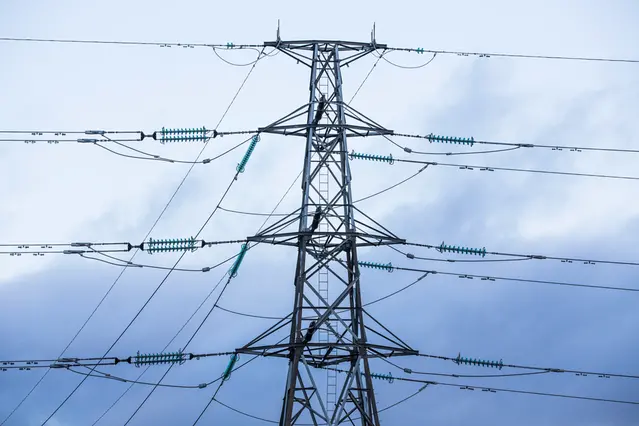
The new project will work with research and development to create an AI model for clouds and wind that can help Svenska kraftnät to balance the power system more easily. Photo: Tomas Ärlemo, Svenska kraftnät.

Tomas Landelius.
"In this pilot project, we are working together with Svenska kraftnät, which has a strong need for information on local cloud and wind conditions in order to calculate how much solar and wind power they can expect in the coming hours and days," says Tomas Landelius. He is a researcher at SMHI’s meteorological research unit and project manager for the newly launched project to develop the AI model.
In the new project, the researchers will build on knowledge from European development projects on digital twins and generative forecasting models, primarily from the European project WeatherGenerator. WeatherGenerator uses machine learning to produce a compact description of the atmosphere that is made openly available. This can be used to simplify the development of other models with specific applications.
Increased operational reliability and reduced cost
Svenska kraftnät is responsible for balancing the power system in a safe and cost-effective manner. For them, improved weather forecasts for the next few hours and the coming day would contribute to increased operational reliability and lower costs for maintaining balance in the system.
"With the AI model, we will achieve shorter computation times for each forecast once the model has been trained. The limiting factor will then primarily be how quickly we can gain access to up-to-date observations, rather than the time it takes to run the forecast model," says Tomas Landelius.
The observations to be used to train the model will come from polar-orbiting satellites that pass over Sweden. Of particular interest is the European polar mini-satellite Arctic Weather Satellite. It provides three-dimensional observations of temperature, humidity and cloud as it travels around the Earth. Data from geostationary satellite systems that provide an overview of the entire globe will also be used. Satellite data will be complemented with data from wind turbines, aircraft and weather radar.
Societal benefit for more users
The project has ambitious goals. Tomas Landelius sees that the development of the AI model for clouds and wind could, in the long term, create societal benefits for more users than Svenska kraftnät alone. The short-term forecasts could, for example, be used in the aviation sector, and for drones that are particularly sensitive to wind and icing. Drones also fly closer to the ground, where many small-scale atmospheric processes occur that are more difficult to describe in existing forecast models.
Short-term forecasts are also important during extreme weather events, such as storms and forest fires. In these situations, knowledge of clouds and local wind conditions can facilitate rescue operations.
The general public may also benefit from improvements in forecasts for the coming hours. The AI model has the potential to contribute to a cloud forecast that more closely resembles the observed cloud cover.
Spreading inspiration around digital twins
The project will also serve as an important demonstrator and source of inspiration for other authorities and stakeholders, showing how the digital twin WeatherGenerator can be used to create concrete societal benefits. WeatherGenerator has been developed through EU-funded research for the Destination Earth platform, an EU initiative to create a digital twin of the Earth.
The project is funded by the Swedish National Space Agency. It runs from 2026 to 2027 and is carried out by SMHI together with Svenska kraftnät.