“Boundless oceans require cross-border cooperation”
Oceanographers from 13 different countries are collaborating on a unique project aimed at increasing the knowledge required for sustainable marine management, particularly with regard to issues of eutrophication. Last week, a large meeting was held in the Netherlands where several key issues were discussed.
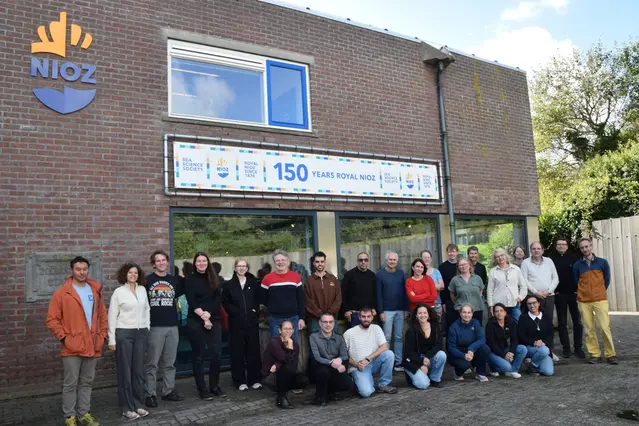
The CodeBlue project team met at the NIOZ office on the island of Texel in the Netherlands.
Eutrophication remains a serious problem for the Baltic Sea and the north-east Atlantic. It affects many marine sectors, such as fisheries, tourism and aquaculture. Eutrophication also leads to oxygen depletion on the seabed. Aquatic species that cannot escape these areas die. The problems of eutrophication are largely caused by humans discharging excessive amounts of nutrients, such as nitrogen and phosphorus, into the sea.
“Boundless seas require cross-border cooperation. All countries bordering the Baltic Sea and the north-east Atlantic contribute to the inflow of nutrients. It is therefore a major success to have brought together so many countries in a single project”, says Elin Almroth Rosell, oceanographer at SMHI and project manager for the project known as CodeBlue.
CodeBlue is a medical term for an emergency. Here, it is the sea that is unwell, and CodeBlue is the cure!
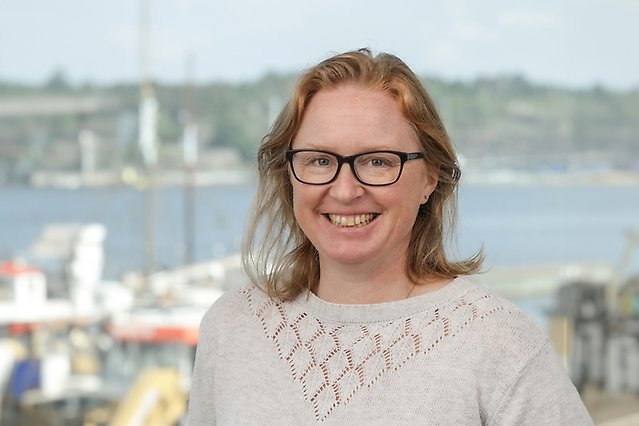
Elin Almroth Rosell, SMHI.
Intense days focusing on method
On 7–9 October, all participating countries gathered for a major meeting on the island of Texel in the Netherlands. The event was hosted by NIOZ, the Royal Netherlands Institute for Sea Research. The researchers discussed a wide range of issues, and the project took significant strides forward.
“They were intense and productive days, with a positive atmosphere during the discussions”, says Elin Almroth Rosell.
“The discussions mainly centred on which methods we should use to compile the data that we feed our various mathematical models with to be able to study how the environment affects the sea. This is important so that we can compare our model results. The input data must be as consistent as possible without compromising the models’ performance. Some aspects of what we’re going to do haven’t been done by anyone before, and since it takes a long time and a lot of resources to run biogeochemical ocean models, we need to be absolutely clear about what the configurations should look like before we start the runs”, says Elin Almroth Rosell.
Arthur Capet, the Royal Belgian Institute of Natural Sciences, adds:
“It is important that we pose and clearly delineating methodological choices in our approach. The constraints are multiple, and so are the expectations, both to be declined within substantial geographical diversity. Yet, time and resource are limited, so we need to prioritize our objectives, and clearly delineate the scientific way forward”, says Arthur Capet.
A great deal of progress was made
Hermann Lenhart, AquaEcology, found the meeting very important since all people involved in the project could see the complexity of the project and got an illustration how the pieces are meant to fit together.
“We also could see that we made progress with important parts like the de-trending and the software for post-processing. We started to discuss timelines and deadlines in a conceptual context of the whole project, from the preparation of the forcing, the simulation, the post-processing and the final delivery to the platforms like EMODnet.”
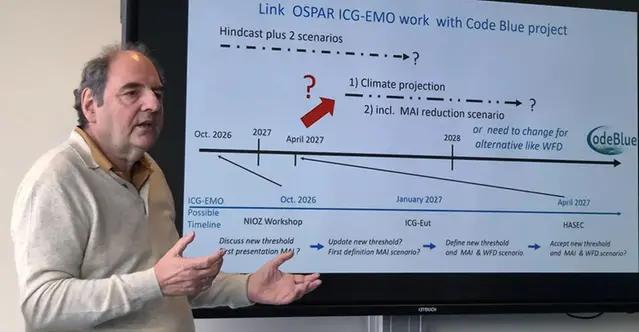
Hermann Lenhart, AquaEcology.
Data that can be used by more researchers
For the future, Hermann Lenhart thinks the project provides improved products to discuss eutrophication in the frame needed for OSPAR and HELCOM:
“But it also offers datasets for the scientific community which allow for in-depth analysis of eutrophication versus climate change effects”, says Hermann Lenhart.
Full steam ahead
Back at their respective institutions, all partners are now continuing their work in line with the deadlines set for the various stages of the project. The CodeBlue project will run until 2028.
EMODnet = The European Marine Observation and Data Network is the European Union's in situ marine data service.
OSPAR = The mechanism by which 15 Governments and the European Union cooperate to protect the marine environment of the North-East Atlantic. OSPAR is so named because of the original Oslo and Paris Conventions.
HELCOM = The Baltic Marine Environment Protection Commission – also known as the Helsinki Commission (HELCOM) – is an intergovernmental organisation (IGO) and a regional sea convention in the Baltic Sea area.
CodeBlue
- CodeBlue is a unique international research project aimed at combating eutrophication: 13 countries around the Baltic Sea and the north-east Atlantic are taking part.
- The project aims to fill knowledge gaps by increasing the knowledge required for sustainable marine management, particularly with regard to eutrophication issues.
- The project’s long-term goal is to develop a plan that makes policy more effective and sustainable, whilst reducing the risk of unnecessary costs in the future.
The three main research questions within CodeBlue:
- Has climate change been a significant factor in the increased input of nutrients into the sea in connection with current eutrophication?
- Will the ‘maximum permissible input’ of nutrients discussed in international agreements be sufficient to solve the eutrophication problem in a changing climate?
- At local level: How will the measures implemented affect the blue economy, for example aquaculture?