
Two new projects aim to improve future climate data
How will our climate change over the coming decades – and what will these changes mean for society? Answering these questions requires more than just climate models. It requires better coordination between different areas of climate research, new modelling methods and effective ways of turning complex climate data into knowledge that can support decisions that are critical to society.
Two exciting European projects, FUTURA and ENES-RISe, have just been launched, and SMHI plays an active role in both. The projects aim to improve the computing tools and systems used for climate modelling and bring different climate research communities closer together.
"Essential for society’s ability to understand and address the climate crisis"
By linking the various stages – from future greenhouse gas emissions to climate projections and information that can be used in practice – the projects will create a better basis for decision-making. Better-informed decisions lead to fairer and more resilient societies.
"Together, the projects tackle two sides of the same challenge: building up the scientific and technical capacity to simulate and understand possible climate scenarios, and making that knowledge usable. This is essential for society’s ability to understand and address the climate crisis", says Torben Koenigk, the climate researcher who leads the projects at SMHI.
A paradigm shift in climate modelling
Currently, the various groups working on climate modelling operate in relative isolation from one another, and within a process where it takes many years to produce usable results.
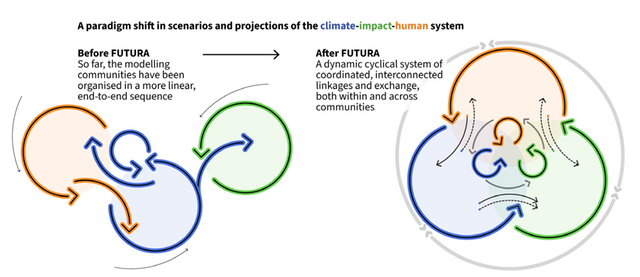
A paradigm shift in scenarios and projections of the climate-impact-human system.
FUTURA aims to develop a new approach to better coordinate the development of emissions scenarios, global projections, regional downscaling and impact modelling. This new cyclical system will speed up the entire process and ensure that everything presented in the reports from the UN’s Intergovernmental Panel on Climate Change (IPCC) is based on the same emission scenarios and the same global models, which is not currently the case.
The work carried out within ENES-RISe will make it easier to use some of the world’s most advanced Earth system models and to manage the vast amounts of climate data they generate. It will also help researchers to better evaluate and understand these models, as well as to transform complex climate data into information that is easier to access and use. In this way, ENES-RISe will support both research into the consequences of climate change and indirectly, contribute to the development of climate services that help society prepare for a changing climate.
SMHI is contributing to the development of tools
SMHI’s contribution to the FUTURA project is to design and carry out new simulations using Earth system models, contribute to regional climate modelling, and develop tools for a more efficient and automated analysis of data from various models and sources.
Within the ENES-RISe project, SMHI will make it easier for other researchers to use SMHI’s global and regional climate models, EC-Earth and HCLIM respectively. In addition, SMHI will contribute to the development of a common tool for the evaluation and analysis of Earth system models, ESMValTool.
By strengthening the entire chain of climate models, infrastructure, data services and analysis tools, SMHI is contributing to a more interconnected European climate research system. This will help ensuring that the best available climate science can reach researchers, practitioners and decision-makers when they need it.
A joint initiative
These new research projects are the result of a joint initiative by leading researchers in European climate research. With funding from the EU, the various research groups can now collaborate to gain a better understanding of changes in the Earth’s climate system and their effects, helping to provide more effective support for policy decisions.
