
Modelling study shows benefits of reduced ammonia emissions
There are clear benefits for both health and the environment from reducing ammonia emissions. In a modelling study, researchers have estimated the effects of reducing emissions of ammonia and nitrogen oxides, respectively. The results clearly show that reducing ammonia emissions yields the greatest impact, although it remains important to also reduce nitrogen oxides.
Ammonia is a nitrogen compound that contributes to the formation of airborne particles that affect both health and climate. It also contributes to nitrogen deposition in ecosystems, causing acidification and eutrophication. In Sweden, agriculture accounts for the largest share of ammonia emissions to air. Emissions mainly arise from the handling and application of fertilisers, both manure and mineral fertilisers. Reducing ammonia emissions is a major challenge, but would lower air pollution levels and protect the environment both in Europe and globally.
A new study from SMHI presents model estimates of atmospheric ammonia in Europe and Sweden. The study uses SMHI’s regional atmospheric chemistry transport model MATCH. The model includes an improved representation of the dry deposition of ammonia, which has been evaluated against measurements from European field sites.
The study focuses on estimating the effects of reducing emissions in Sweden. Sweden is one of the EU countries that currently does not meet its targets for reducing ammonia emissions. In addition, ammonia emissions from other countries reach Sweden through atmospheric transport.
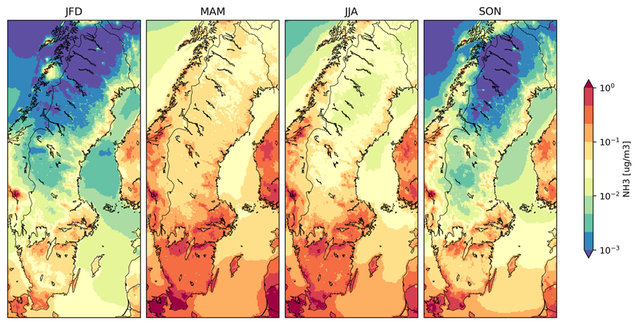
The maps show seasonal mean concentrations of ammonia in Sweden for 2019, modelled using MATCH. Concentrations are higher in spring and summer (the two middle panels) than in winter (left) and autumn (right).
Seasonal variation in the effects of emission reductions
The modelling results show that it is possible to reduce ammonia concentrations, fine particulate matter (PM2.5), and nitrogen deposition in Sweden by lowering domestic ammonia emissions. The effects vary clearly by season. The impact on PM2.5 is greatest during winter, when ammonia concentrations are low.
"This is because ammonia contributes to particle formation by reacting with sulphur and nitrogen compounds. Particle formation is limited by the compounds present at the lowest concentrations," explains Tinja Olenius, air quality researcher at SMHI and one of the scientists behind the study.
Nitrogen deposition, on the other hand, decreases most during summer, when ammonia concentrations are higher.
"This is because deposition from the atmosphere to the surface is more directly linked to concentrations in the air," says Tinja Olenius.
Advantages of focusing on ammonia reductions
The researchers compared the effects of reducing ammonia emissions from agriculture with reducing nitrogen oxide (NOx) emissions from road transport, which is the other major source of nitrogen emissions in Sweden.
"From an air quality perspective, it is important to also reduce NOx levels, but according to the model estimates, reduced NOx emissions have little or no effect on PM2.5 and nitrogen deposition. This demonstrates the benefits of cutting ammonia emissions for both health and the environment. The study also shows the potential of national measures to reduce air pollution," says Robert Bergström, air quality researcher at SMHI.
The study was carried out within the project “Nordic Nature & Nitrogen – Improved nitrogen deposition to Nordic nature”, funded by the Nordic Council of Ministers, as well as within SMHI’s method development for the MATCH model. A scientific article is available in the journal Tellus B:
