
The probability of heat waves like those seen in the summer of 2018 has doubled
A study from published last year SMHI shows that there is at least twice the probability of a heat wave similar to that seen in the summer of 2018 occurring, due to human impact on the climate. But how do researchers actually know this? Here they explain!

Erik Kjellström, Professor of climatology at SMHI.
A clear increase in extreme weather events such as heat waves and torrential rain can be observed globally as a result of human greenhouse gas emissions. This means that when an extreme weather event occurs, SMHI is often asked: “Did it happen because of climate change?” But the answer is not entirely straightforward.
– We know that the probability of certain types of extreme weather events increases with global warming. But it is usually not possible to say that a single event is due to climate change. In most cases, there is a possibility that the event could have occurred anyway, but the probability of it occurring is higher due to humanity's current impact on the climate, says Erik Kjellström, professor of climatology and co-author of the study.
Investigated heat waves and torrential rain
Studies that investigate whether and to what extent global warming increases the probability of specific weather events are called attribution studies. SMHI's attribution study investigated the probability that two weather events would have occurred without human impact on the climate. One was a torrential rain event like the one in Gävle in the summer of 2021, and the other was a heat wave like the one Sweden experienced in the summer of 2018.
– For a heat wave like the one in 2018, we saw that the probability has at least doubled due to human influence. However, we were unable to determine whether the probability of torrential rain like that in Gävle in 2021 had increased, explains Erik Holmgren, a doctoral student at Chalmers in climate and atmospheric science, former employee at SMHI, and lead author of the study.
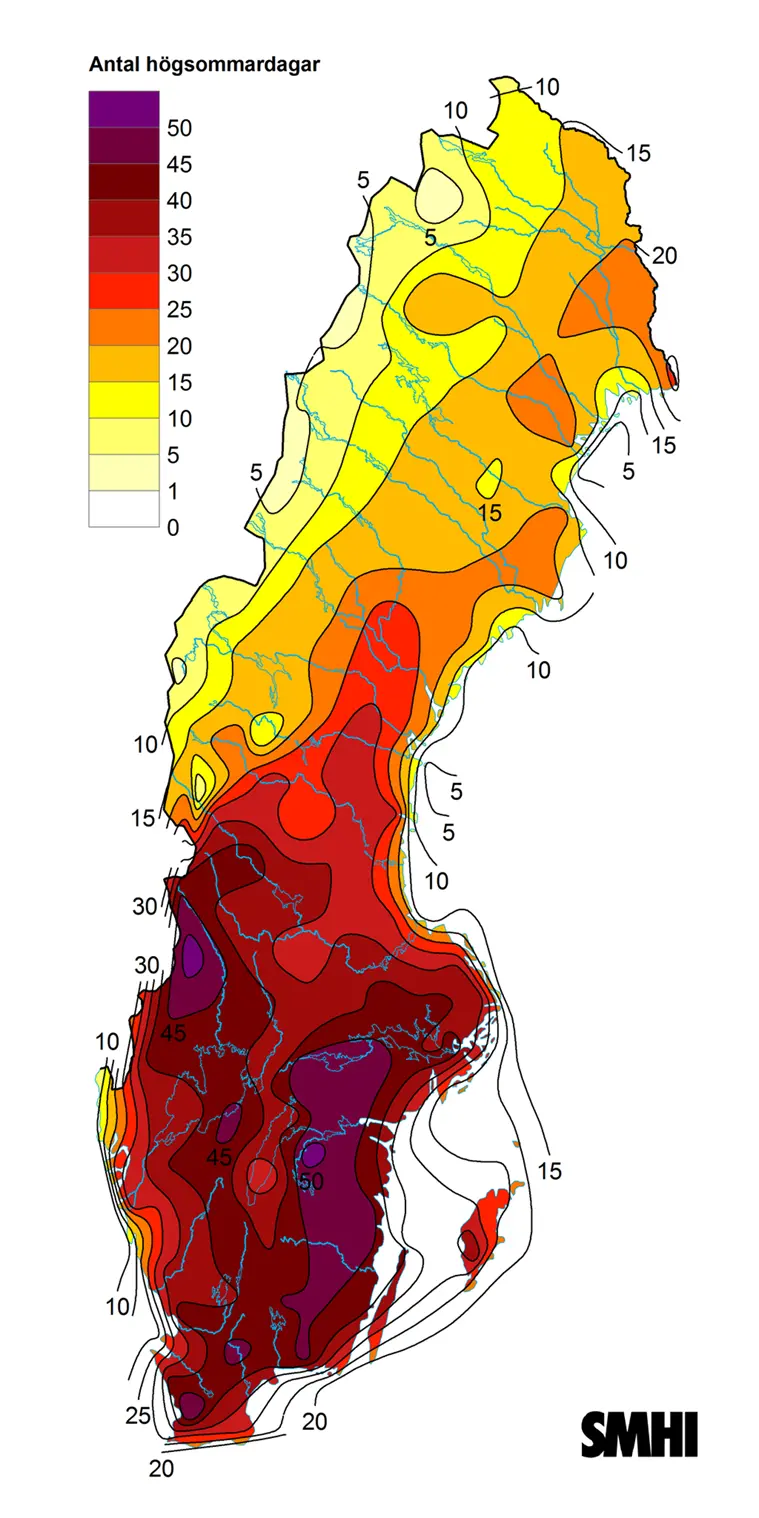
The map shows the number of high summer days during the summer of 2018, i.e. days when the temperature reaches at least 25 degrees Celsius. This was an indicator used in the study to compare the 2018 heatwave with the pre-industrial climate.
Why can we say more about some events than others?
– Attribution works better for large-scale weather phenomena such as the 2018 heatwave, which lasts for a longer period of time and affects larger areas. The torrential rain in Gävle was a more local event that lasted for a shorter period of time, which makes it more difficult to analyze, says Holmgren.
This is how the researchers conducted the attribution study:
Two different methods were used in the study to investigate human influence on weather events:
- The same method used by the research network behind World Weather Attribution: Here, climate models and weather data are used to calculate what a hypothetical present-day climate would have looked like without human climate impact. The hypothetical climate is then compared with today's climate. This makes it possible to calculate how much the probability of extreme weather events has increased.
- Historical observations: The long series of measurements available in Sweden enable researchers to compare the occurrence of extreme weather events similar to the 2018 heatwave and the 2021 torrential rain in Gävle over the last 30 years with the occurrence of similar events during a 30-year pre-industrial period. Researchers can then directly calculate whether, and how, the probability of these events has changed between the two periods.
– The study shows that the two methods give comparable results, which supports the conclusion that the probability of severe heat waves such as the one we experienced in the summer of 2018 has increased as a result of human climate impact, says Erik Kjellström.